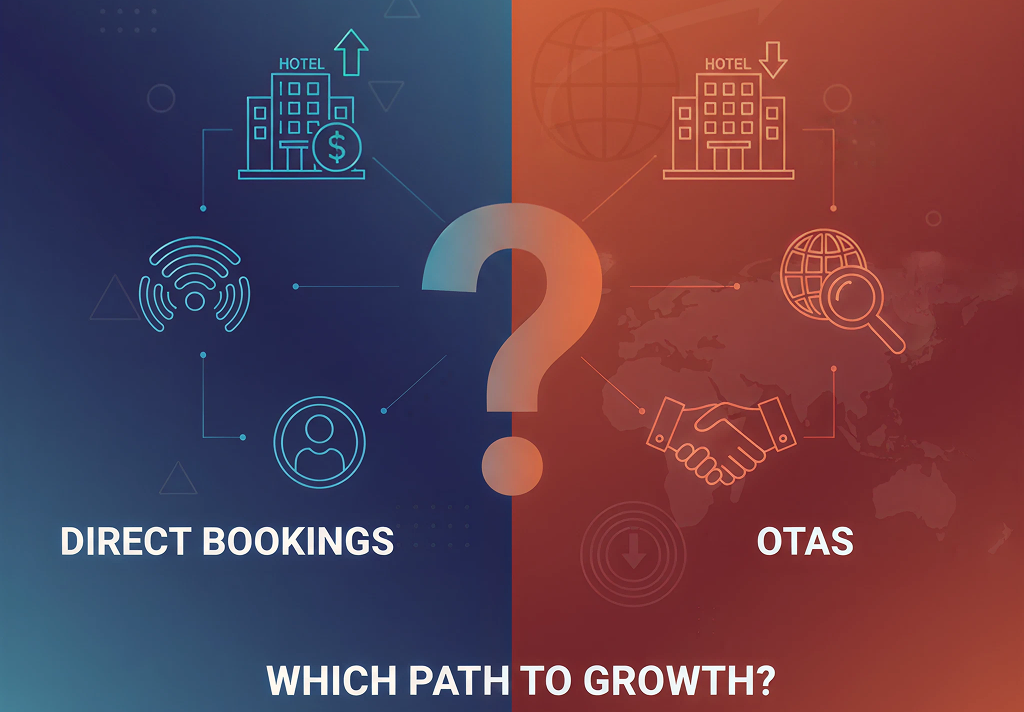
As a hotel owner or manager, you’re constantly seeking the best way to fill your rooms and maximize revenue.
You’ve probably come across two key terms in the industry: Direct Bookings and OTAs (Online Travel Agencies).
But what do these really mean for your hotel, and which one is the best option to focus on?
The truth is, both direct bookings and OTAs have their place in a well-rounded hotel distribution strategy.
Each comes with its own set of pros and cons, and understanding how they impact your revenue and guest experience is key. Let’s break it down.
Direct Bookings vs OTAs: What’s the Difference?
| Feature | Direct Bookings | OTAs (Online Travel Agencies) |
|---|---|---|
| Cost | Lower (no commission fees) | Higher (commission fees up to 20-25%) |
| Guest Data | You control all guest data | Limited access to guest information |
| Visibility | Limited to your own website/marketing | Huge global reach and visibility |
| Control Over Pricing | Full control over rates and promotions | Price parity clauses limit flexibility |
| Customer Loyalty | Direct relationships, loyalty programs | Less opportunity for building loyalty |
| Booking Volume | Dependent on your marketing efforts | Large volume of bookings from third parties |
What Are the Benefits of Direct Bookings?
Direct bookings happen when a guest books directly through your hotel’s website, reservation system, or over the phone. These bookings are highly valuable for a number of reasons:
- Lower Distribution Costs: When you secure a booking directly, you don’t have to pay a commission to an OTA. This can be a significant cost saving. For instance, if your average room rate is $200, and you’re paying a 15% commission to an OTA, that’s a $30 commission fee per booking.
- Better Control Over Pricing: You set the prices, promotional offers, and discounts. Unlike OTAs that may require price parity (where your rate must match what’s listed on their site), you have full control to experiment with offers or last-minute discounts.
- Guest Loyalty and Data: Direct bookings allow you to establish a direct relationship with your guests. This means you can build loyalty programs, collect important guest preferences, and retarget them for future bookings through email marketing or special promotions.