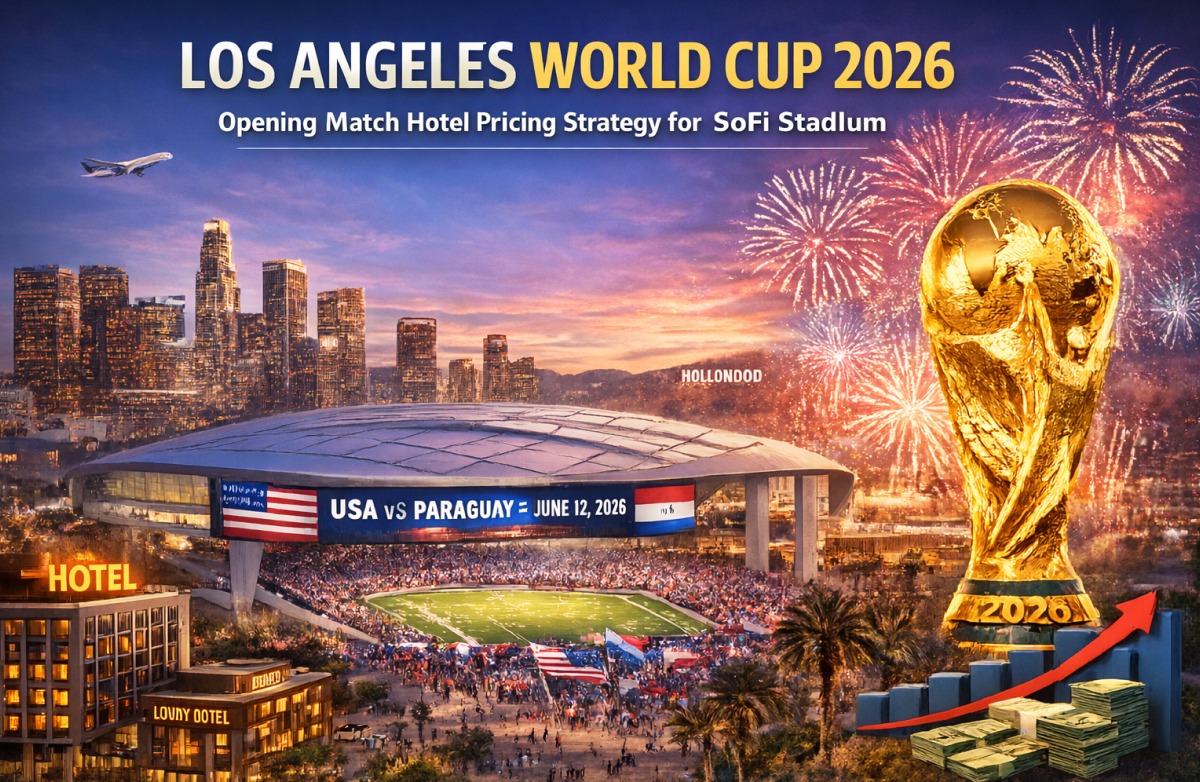
Los Angeles will host eight FIFA World Cup 2026 matches at SoFi Stadium, including the USA’s opening match against Paraguay on June 12 - the first match the host nation plays on home soil. Hotels within 15 miles of SoFi Stadium in Inglewood should expect ADR uplifts of +100–150% on opening night, with projected market occupancy reaching 84% across greater LA during peak match dates. For revenue managers, the LA market offers the earliest pricing compression window of any U.S. host city - but also the highest risk of underpricing due to the city’s vast, fragmented hotel supply.
This is the first installment in RevEVOLVE’s City Deep Dive series, where we break down each FIFA 2026 host city’s hotel market, match schedule, demand projections, zone-by-zone pricing intelligence, and the specific revenue signals that matter most for properties in and around the market. We start with Los Angeles because it hosts the earliest high-demand match in the tournament and presents unique challenges that every LA-area hotelier needs to understand now - not in June.
If you haven’t read our series primer on booking window compression during World Cups, start there. The patterns we documented from Russia 2018 and Qatar 2022 are the foundation for every pricing recommendation in this guide.
Why Los Angeles Is the Most Complex World Cup Hotel Market
Every host city has its pricing challenges. But LA is structurally different from Dallas, Miami, or Kansas City for three reasons that directly affect your revenue strategy.
1. Massive, Fragmented Hotel Supply
Greater Los Angeles has over 100,000 hotel rooms spread across dozens of submarkets. That’s more supply than any other host city by a factor of 2–3x. The LA hotel market recorded 70.3% occupancy with an ADR of $194 and RevPAR of $136.51 in Q3 2025, according to Matthews Real Estate. While these baseline numbers are solid, the sheer volume of rooms means demand must be genuinely massive to move the entire market. A single match doesn’t compress LA the way it compresses Kansas City (where limited supply amplifies every booking).
2. SoFi Stadium’s Location Creates a Natural Pricing Gradient
SoFi Stadium sits in Inglewood, about 3 miles east of LAX and 12 miles southwest of Downtown LA. This creates a clear demand gradient. Properties in Inglewood and the LAX airport corridor (1–5 miles from the stadium) will see the strongest compression. Downtown LA hotels (12 miles) will see moderate uplift. Santa Monica and Westside properties (10 miles) benefit from tourism demand but less from match-night urgency. Hotels in Anaheim, Long Beach, and Pasadena function as spillover markets with +20–45% ADR uplift when the primary zones approach sellout.
3. The “Event Stack” Creates Unprecedented Context
LA is the only city in the world hosting three of the biggest sporting events in a 3-year window: the 2026 FIFA World Cup, the 2027 Super Bowl LXI (also at SoFi Stadium), and the 2028 Summer Olympics. This sequence is reshaping the entire Inglewood submarket. The Kali Hotel - a 300-room, 13-story Marriott Autograph Collection property - is under construction immediately adjacent to SoFi Stadium and is scheduled to open by spring 2026, specifically timed for World Cup demand. When Super Bowl LVI was held at SoFi in February 2022, LA hotels recorded an average ADR of $445 for the weekend, according to STR. The World Cup will produce not just one peak weekend, but eight match dates spread across 28 days, each with its own demand profile.
The Complete LA Match Schedule: 8 Matches, 5 Demand Tiers
SoFi Stadium (temporarily renamed “Los Angeles Stadium” per FIFA policy) will host eight matches. Understanding the demand profile of each match is the foundation of your pricing strategy. Not all match nights are created equal.
| Date | Match | Stage | Demand | ADR Uplift | Revenue Signal |
|---|---|---|---|---|---|
| Jun 12 | USA vs Paraguay | Group D | EXTREME | +100–150% | USA opener. Max patriotic surge. Earliest SoFi sellout. |
| Jun 15 | Iran vs New Zealand | Group G | MODERATE | +20–35% | Lower-profile. Mispricing trap if overpriced. |
| Jun 19 | Argentina vs Egypt | Group J | VERY HIGH | +70–100% | Messi draw. Strong Latin American diaspora. |
| Jun 22 | Iran vs Group G TBD | Group G | MODERATE | +20–35% | Second Iran match. Watch ticket sales for fan volume. |
| Jun 25 | USA vs Group D TBD | Group D | EXTREME | +90–130% | USA’s 3rd group match. Elimination drama lifts ADR. |
| Jun 29 | Round of 32 (M57) | R32 | VERY HIGH | +60–90% | Booking window: 7–14 days. Wait for team path. |
| Jul 1 | Round of 32 (M58) | R32 | HIGH | +50–80% | Team-dependent. Pre-load contingent rate tiers. |
| Jul 10 | QUARTERFINAL | QF | EXTREME | +100–170% | Peak knockout pricing. 5–7 day booking window. |
Key insight: LA has three EXTREME demand dates (June 12, June 25, July 10) and two MODERATE dates (June 15, June 22). The gap between these tiers is enormous - a +100–150% ADR uplift vs. a +20–35% uplift. Hotels that price all eight match nights the same are leaving significant revenue on the table on the highs and risking empty rooms on the lows.
LA Hotel Zones: Where Demand Hits Hardest
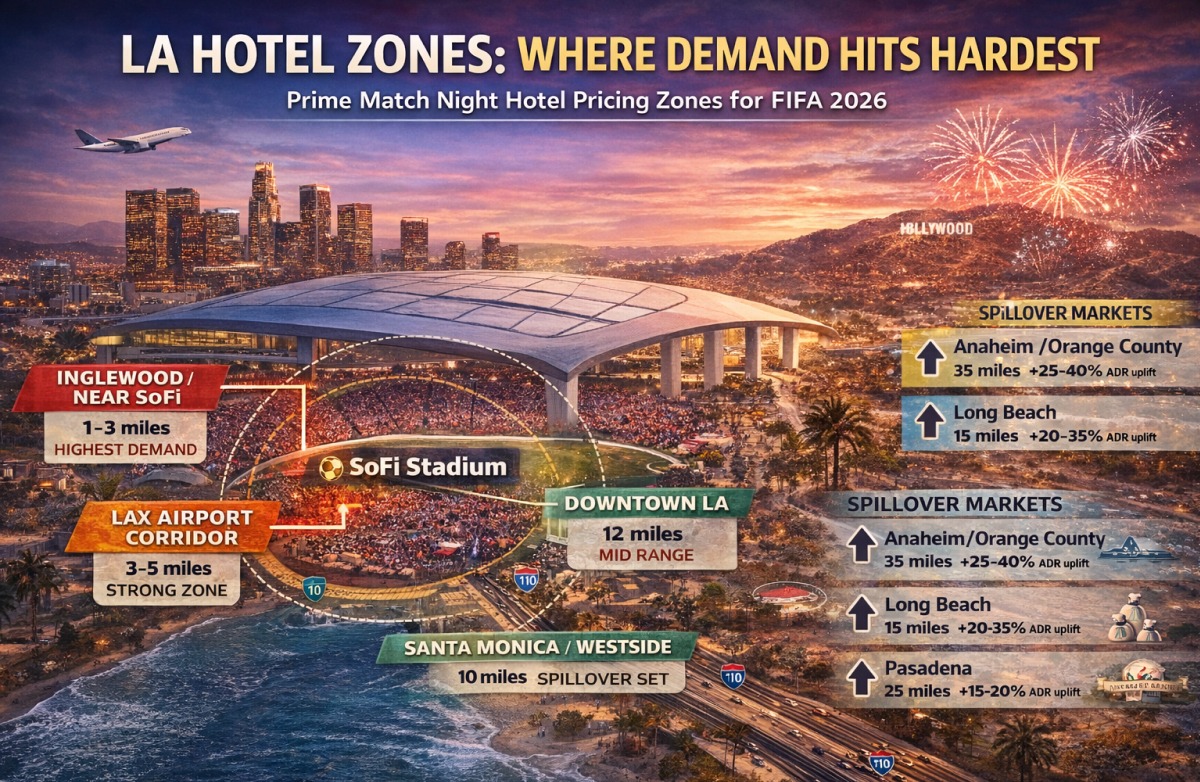
Understanding which zone your property falls into determines your pricing ceiling, booking window behavior, and channel strategy. We’ve mapped five primary zones based on proximity to SoFi Stadium, transportation access, and historical mega-event demand patterns.
| Hotel Zone | Distance | Key Properties | Demand Tier | Pricing Notes |
|---|---|---|---|---|
| Inglewood / near SoFi | 1–3 miles | Kali Hotel (new), motels, limited-service | PRIME | Highest ADR ceiling. Sells out first. Non-refundable only. 3-night min on QF. |
| LAX Airport Corridor | 3–5 miles | Hilton, Marriott, Hyatt, IHG clusters | HOT | Strongest branded hotel zone. Price at 90–95% of Inglewood. Airport demand adds floor. |
| Downtown LA | 12 miles | Full-service, luxury, convention hotels | STRONG | Match-day packages + F&B drive total RevPAR. Transit accessible via Metro. |
| Santa Monica / Westside | 10 miles | Boutique, lifestyle, resort-style | MODERATE | Tourism-driven. Extend stays with beach + match bundling. 2-night min. |
| I-405 South Bay Corridor | 5–15 miles | Select-service, extended-stay | MODERATE | Value positioning. Captures overflow from Inglewood/LAX zones. Highway access key. |
Spillover Markets: When LA Tightens
When occupancy in the Inglewood and LAX zones exceeds 85–90%, demand spills into three secondary markets. Revenue managers in these markets should monitor host-city availability daily inside 14 days of each match:
Anaheim / Orange County (35 miles): Disneyland-area hotels capture families who combine World Cup with theme parks. Expected uplift: +25–40% ADR on EXTREME match dates.
Long Beach (15 miles): Closest spillover market with convention-quality hotels. Expected uplift: +20–35% ADR. Strong value positioning vs. Inglewood pricing.
Pasadena (25 miles): Rose Bowl corridor hotels benefit from fan gathering demand. Expected uplift: +15–30% ADR. Transit connectivity matters here.
June 12: The USA Opening Match - Your Highest-ADR Night
The USA vs. Paraguay match on June 12 is the single most important revenue date for LA-area hotels. Here’s why, and how to price it.
What Makes This Night Different
Patriotic surge demand. The host nation’s opening match at a home World Cup is a once-in-a-generation event. The last time the USA hosted a World Cup was 1994. The emotional weight of this match creates demand that isn’t price-sensitive. Fans aren’t comparing your rate to last Tuesday - they’re comparing it to the cost of missing the moment.
Longest booking window of the tournament. Unlike knockout matches where booking windows compress to 3–10 days, the opening match date is known now. Fans are already searching. This means your earliest bookings arrive at your lowest published rate unless you’ve already set rate floors. If your June 12 rate is still at standard BAR, you are underpriced today.
9 PM ET kickoff extends the revenue window. A prime-time West Coast kickoff (6 PM local) means pre-match dining, post-match celebrations, and a virtual guarantee of two-night stays (June 11–12 minimum). Set your LOS minimum accordingly.
Opening Match Pricing Framework by Property Type
| Property Type | Normal ADR | Jun 12 Target ADR | Strategy |
|---|---|---|---|
| Boutique (<120 rooms) | $150–$250 | $375–$625+ | Price at top of comp set. Non-refundable. Close OTAs. Direct-only. |
| Midscale / Select (120–250) | $130–$180 | $260–$450 | Tier by demand. Hold 15–20 rooms. 2-night min. Watch cancellations. |
| Full-Service (250–500) | $200–$300 | $400–$750 | Match-day packages (room + F&B + screening). Suites at 2–3x. Review group blocks. |
| Large / Resort (500+) | $250–$400 | $500–$1,000+ | 3-bucket allocation: 60% base, 25% hold, 15% premium reserve. F&B/events = $50–100K+. |
5 Pricing Mistakes LA Hotels Will Make (and How to Avoid Them)
Mistake 1: Flat-Rate World Cup Surcharge
Some hotels will set a single “World Cup premium” across all eight match dates. This is the most common and most costly error. USA vs. Paraguay (June 12) is not the same market as Iran vs. New Zealand (June 15). One commands EXTREME demand with +100–150% ADR uplift; the other is MODERATE at +20–35%. A flat surcharge either leaves money on the table on your highest-demand nights or prices you out of the market on lower-demand dates. Tier your pricing by match demand level.
Mistake 2: Using STLY as Your Benchmark
Same Time Last Year (STLY) is the default benchmark for most revenue managers. But June 2025 had no World Cup. Your STLY comp is useless for demand forecasting on these dates. Instead, track 7-day pickup velocity - the rate of change in bookings, not the absolute OTB level. A date moving from 8% to 16% OTB in 10 days is accelerating hard. A date stuck at 15% for three weeks is stalling. The trend is the signal, not the number.
Mistake 3: Discounting Low-OTB Knockout Dates
The LA quarterfinal on July 10 will show alarming OTB numbers at 30 days out. Revenue managers trained on normal demand patterns will be tempted to lower rates or open discount channels. Do not do this. Knockout booking windows compress to 5–7 days because fans cannot book until their team advances. Low OTB at 14+ days is the structural reality of elimination tournaments, not weak demand. Hotels that hold firm will sell out at peak rates in the final week.
Mistake 4: Ignoring Shoulder Night Revenue
Shoulder nights - the night before and the night after a match - typically achieve 60–80% of match-night ADR premium during mega-events. For a June 12 match, June 11 is a high-value shoulder night. Yet many hotels only price the match date itself at premium. Implement 2-night minimum length of stay (LOS) on all EXTREME demand matches to protect shoulder night revenue and prevent single-night cherry-picking.
Mistake 5: Leaving Group Blocks Unreviewed
If your hotel has corporate or group blocks sitting on World Cup dates at pre-negotiated rates, you are potentially giving away your highest-revenue rooms at your lowest rates. Review every group block touching June 11–July 11 now. Renegotiate rates to reflect event demand. Release unused block rooms back into transient inventory. A 200-room hotel holding 40 group rooms at $180 during a night where transient demand would pay $500 is leaving $12,800 on the table on that single date.
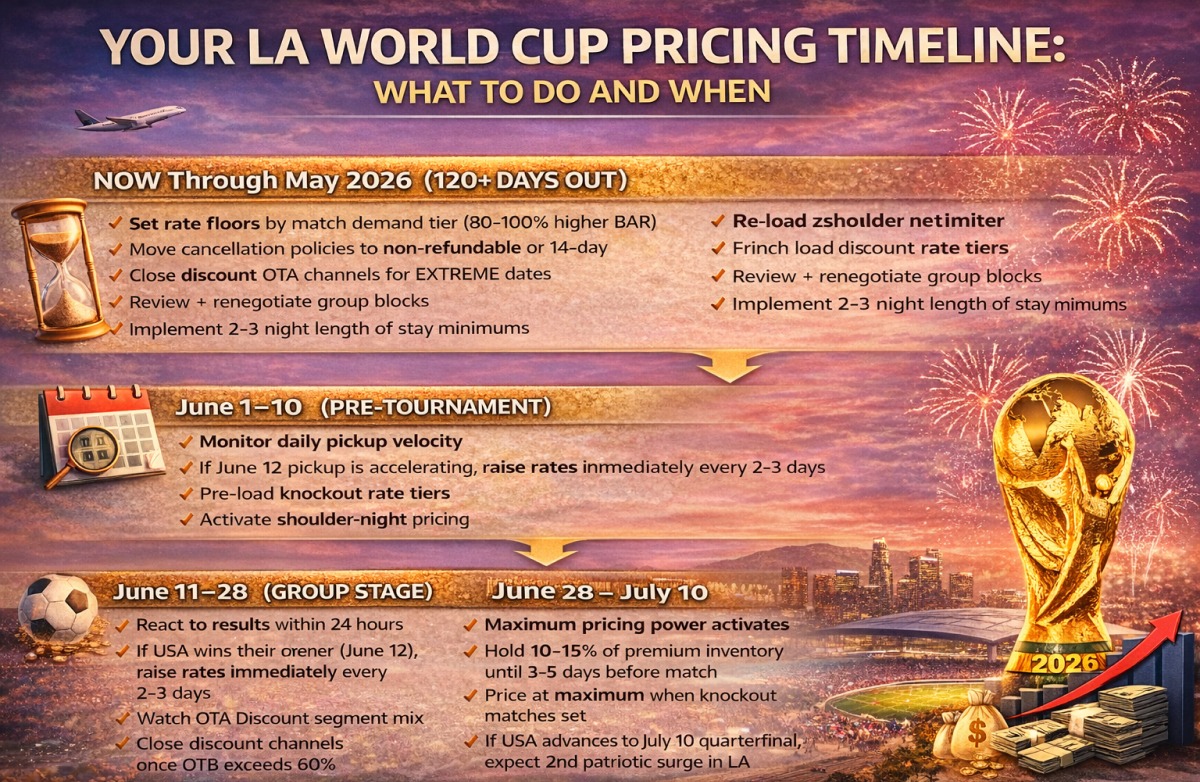
Your LA World Cup Pricing Timeline: What to Do and When
NOW Through May 2026 (120+ Days Out)
Set rate floors by match demand tier. Your June 12 (USA opener) and July 10 (quarterfinal) rates should already be 80–100% above normal BAR. Move cancellation policies to non-refundable or 14-day cancellation for all World Cup dates. Close discount OTA channels (flash sales, member-only rates, opaque channels) for EXTREME demand dates. Review and renegotiate every group block. Implement 2–3 night LOS minimums on EXTREME match dates.
June 1–10 (Pre-Tournament)
Monitor daily pickup velocity. If June 12 pickup is accelerating, raise rates incrementally every 2–3 days. Pre-load knockout rate tiers so you can execute instantly when the Round of 32 and quarterfinal matchups are confirmed by group-stage results. Activate shoulder-night pricing for June 11 and June 13.
June 11–28 (Group Stage)
React to results within 24 hours. If the USA wins their opener (June 12), demand for June 25 (USA’s third match) surges immediately - raise rates. If a major team is eliminated, deflation hits the next city hosting their remaining matches. Watch OTA Discount segment mix: if it exceeds 40% of total bookings on match nights, your rate floor is too low. Close discount channels once OTB exceeds 60% for any match date.
June 28 – July 10 (Knockout Rounds)
Maximum pricing power activates. The Round of 32 (June 29, July 1) and quarterfinal (July 10) will see booking windows collapse to 5–10 days. Hold 10–15% of your premium inventory until 3–5 days before each match. These are your highest-ADR rooms. Price at absolute maximum. If the USA advances to the quarterfinal in LA on July 10, expect a second patriotic surge even stronger than June 12 - because now it’s a win-or-go-home match. Spillover demand activates for Anaheim, Long Beach, and Pasadena.
The Pacific Rim Factor: International Demand Unique to LA
Los Angeles is the primary U.S. gateway for Pacific Rim travel. LAX handles over 16 million international passengers annually, with the heaviest routes connecting to Asia and Latin America. Two of LA’s eight matches involve Iran, which has a significant diaspora in the LA metro area (often called “Tehrangeles”). The Argentina match on June 19 will draw the massive Latin American population across Southern California. And any East Asian team advancing through the LA bracket will trigger last-minute inbound travel from Asia.
For revenue managers, this means: international booking channels and OTA visibility matter more in LA than in any other host city. Ensure your rates and availability are correctly loaded on Booking.com, Agoda, and Trip.com. International fans book later and pay more. Don’t restrict channels that serve this audience prematurely.
How RevEVOLVE Helps LA Hotels Capture Peak World Cup Revenue
The pricing intelligence in this blog comes from the same data framework that powers RevEVOLVE’s demand forecasting engine. For properties in the LA market, RevEVOLVE provides:
Match-level demand signals. RevEVOLVE’s Smart Signals track 7-day pickup velocity, comp set rate movements, and segment mix shifts for every match date - not just overall market trends. When the USA-Paraguay match on June 12 starts accelerating, you’ll see the signal before your comp set reacts.
What-If Scenario modeling. RevEVOLVE’s What-If Simulator lets you model team-contingent pricing - what happens to your July 10 quarterfinal rate if Argentina advances vs. if they don’t? Pre-load rate tiers and execute in seconds when results confirm.
Zone-specific comp set intelligence. RevEVOLVE’s competitive intelligence module tracks Rate Position Index for your specific zone (Inglewood, LAX corridor, Downtown, etc.), not just the broad LA market. When your Inglewood comp set raises rates overnight, you’ll know within hours.
The Bottom Line: LA Is the Opening Act - Price Like It
Los Angeles hosts the USA’s opening World Cup match on June 12, 2026 - the earliest high-demand date in the entire tournament. Hotels that set tiered rates now, implement LOS requirements, hold premium inventory for knockout compression, and monitor zone-specific signals will capture the full revenue potential of eight match dates spanning 28 days. Hotels that wait, use flat surcharges, or benchmark against STLY will leave hundreds of thousands of dollars uncaptured.
Next in the series: Blog 6: City Deep Dive - Kansas City, where we examine how limited hotel supply in a mid-tier market creates the highest ADR compression potential of any World Cup host city.
Frequently Asked Questions (FAQs)
SoFi Stadium in Inglewood will host eight FIFA World Cup 2026 matches: five group stage matches and three knockout round matches (two Round of 32 and one quarterfinal). The most significant dates are June 12 (USA vs. Paraguay, the host nation’s opening match), June 25 (USA’s third group match), and July 10 (the quarterfinal). SoFi will be temporarily renamed “Los Angeles Stadium” per FIFA policy.
ADR uplift varies dramatically by match. EXTREME demand dates (June 12 USA opener, June 25 USA third match, July 10 quarterfinal) project +100–170% ADR uplift above normal rates. VERY HIGH dates project +60–100%. MODERATE dates project +20–35%. When Super Bowl LVI was held at SoFi in 2022, LA hotels averaged $445 ADR for the weekend. World Cup demand produces multiple peak weekends across 28 days rather than a single event weekend.
The Inglewood / near SoFi zone (1–3 miles) will see the highest demand and ADR ceiling. The LAX Airport Corridor (3–5 miles) is the strongest branded hotel zone with pricing at 90–95% of Inglewood. Downtown LA (12 miles) benefits from full-service and luxury positioning with match-day package opportunities. When primary zones approach sellout, spillover activates in Anaheim (35 miles), Long Beach (15 miles), and Pasadena (25 miles) with +20–45% ADR uplift.
Hotels should set rate floors for EXTREME demand match dates now - at least 120 days out. The USA’s opening match on June 12 has the longest booking window of any LA match because the date and opponent are already confirmed. Hotels waiting until closer to the event risk capturing early bookings at standard BAR rates. For knockout matches (Round of 32 and quarterfinal), pre-load rate tiers now but expect the actual booking window to be 5–10 days.
The Kali Hotel is a 300-room, 13-story Marriott Autograph Collection property currently under construction adjacent to SoFi Stadium within the Hollywood Park development. It is the only hotel located within Hollywood Park and is scheduled to open by spring 2026, specifically timed for World Cup demand. The hotel will also serve Super Bowl LXI in 2027 and the 2028 Summer Olympics. It will be the closest branded hotel to SoFi Stadium.