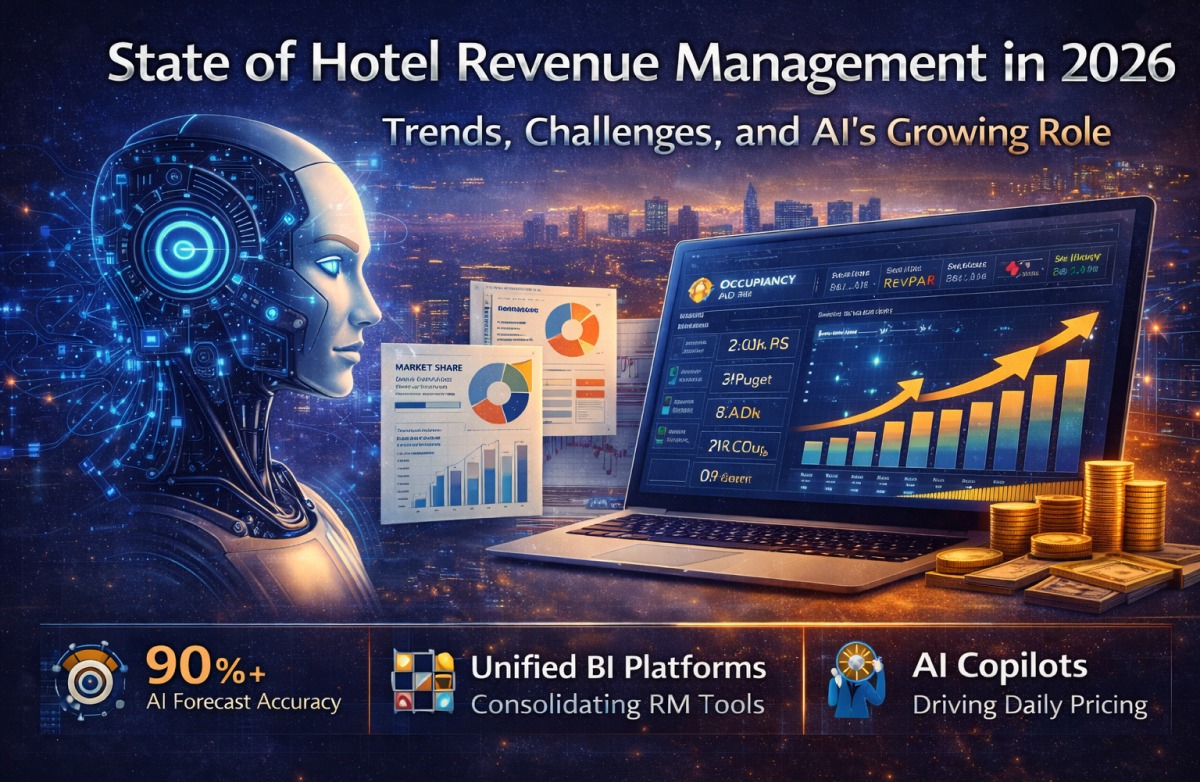
Hotel revenue management in 2026 is defined by three fundamental shifts: AI-powered demand forecasting now achieves accuracy rates exceeding 90%, standalone RM tools are consolidating into unified business intelligence platforms, and AI copilots are handling daily pricing decisions that once consumed hours of manual analysis. These shifts are reshaping how every hotel, RMC, and management company approaches revenue optimization.
If you’re a revenue manager, GM, or RMC owner reading this in 2026, your daily workflow looks dramatically different than it did even 18 months ago. The spreadsheets haven’t disappeared entirely-but they’re no longer the center of gravity.
Consider this: 67% of hotels with 100+ rooms now use some form of AI-assisted pricing, up from 41% in 2024 according to industry surveys. Revenue management companies that adopted AI-powered BI platforms in 2024–2025 are reporting 50–80% increases in properties managed per RM without adding headcount. Meanwhile, hotels still relying solely on manual rate setting are falling further behind their comp sets.
This blog breaks down the five defining trends shaping hotel revenue management in 2026, the challenges that persist despite technological progress, and what the data tells us about where the industry is heading. Whether you manage a single boutique property or a 200-hotel portfolio, these shifts will directly impact your revenue strategy this year.
Why AI Demand Forecasting Has Become the New Baseline for Hotels
The single biggest shift in hotel revenue management 2026 is the maturation of AI-powered demand forecasting. What was experimental in 2023 is now table stakes for competitive properties.
Modern AI forecasting engines use ensemble models that blend five or more independent data signals-on-the-books(OTB) pickup velocity, historical seasonal patterns, local market events, competitive rate movements, and real-time booking pace-to predict occupancy at the property level with segment-level granularity.
The results speak for themselves. Properties using AI-powered forecasting are reporting 90–94% forecast accuracy at 30 days out, compared to 70–75% accuracy from manual methods. That 20-point accuracy gap translates directly to better pricing decisions, fewer missed revenue opportunities, and more confident rate positioning against comp sets.
Forecast Accuracy Comparison: AI vs. Manual Methods
| Metric | Manual RM | Basic RMS | AI Ensemble |
|---|---|---|---|
| 30-Day Forecast Accuracy | 70–75% | 80–85% | 90–94% |
| Forecast Update Frequency | Weekly | Daily | Real-time |
| Segment-Level Granularity | Limited | Moderate | Full |
| Event Impact Modeling | Manual only | Rules-based | Dynamic + learned |
| Avg RevPAR Impact | Baseline | +3–5% | +8–15% |
What makes 2026 different from previous years is accessibility. AI forecasting is no longer exclusive to large chains with dedicated data science teams. Cloud-based platforms have made enterprise-grade forecasting available to independent hotels starting at under $300/month-a price point that was unthinkable three years ago.
The Consolidation of RM Tools into Unified BI Platforms
For years, revenue managers juggled a patchwork of disconnected tools: one system for rate shopping, another for forecasting, a third for reporting, and a spreadsheet to tie it all together. In 2026, the industry is consolidating around unified business intelligence platforms that bring forecasting, competitive intelligence, dynamic pricing,booking pace analysis, and reporting into a single interface.
This consolidation trend is being driven by three forces. First, data silos kill decision speed. When a revenue manager has to pull data from four systems to answer a simple question about next Tuesday’s pricing, the decision is already late. Unified platforms reduce the average RM decision time from 45 minutes to under 5 minutes for routine pricing adjustments.
Second, RMCs and management companies need portfolio-level visibility. Managing 30, 50, or 100+ properties from disconnected tools is operationally unsustainable. Unified dashboards that surface exceptions across an entire portfolio-which property is behind pace, where a comp set rate gap opened, which market segment is underperforming-enable a single RM to effectively manage 15–20 properties instead of the traditional 8–12.
Third, AI features require integrated data. An AI copilot that can answer “Why is my Thursday occupancy trending 8 points below STLY?” needs access to booking data, comp rates, event calendars, and historical patterns simultaneously. Fragmented tools simply can’t support this level of intelligence.
How AI Copilots Are Changing Daily RM Workflows
Perhaps the most visible shift in hotel revenue management 2026 is the rise of AI copilots-intelligent assistants embedded in RM platforms that handle the repetitive 60–70% of a revenue manager’s daily workload.
Think about what a typical RM’s morning looks like without an AI copilot: pull the night audit, review OTB by day, check pickup against STLY, scan competitor rates, flag any anomalies, update the rate calendar, and prepare a summary for the GM or owner. That process takes 2–3 hours per property. Multiply by 10 properties, and your RM is spending their entire day on data assembly-not strategy.
AI copilots compress that entire workflow into an automated daily briefing delivered before the RM finishes their coffee. The briefing covers overnight pickup, pace vs. STLY, competitive rate movements, demand signals, and specific recommendations-all in natural language, no report-building required.
The productivity impact is measurable. Revenue managers using AI copilots report saving 15–20 hours per week on routine tasks. That freed time redirects to high-impact strategic work: owner relationship management, group pricing negotiations, long-range demand calendar analysis, and competitive positioning.
Key Insight: Revenue managers using AI copilots save 15–20 hours per week on routine tasks-freeing time for the strategic 20–30% of decisions that drive 80% of revenue impact.
For RMCs specifically, the copilot model is an operational leverage multiplier. An RMC that equips its team with AI copilots can realistically scale from 10 properties per RM to 15–20 properties per RM without sacrificing service quality-effectively increasing revenue-per-employee by 50–80%.
RevPAR Benchmarks and Market Performance in 2026
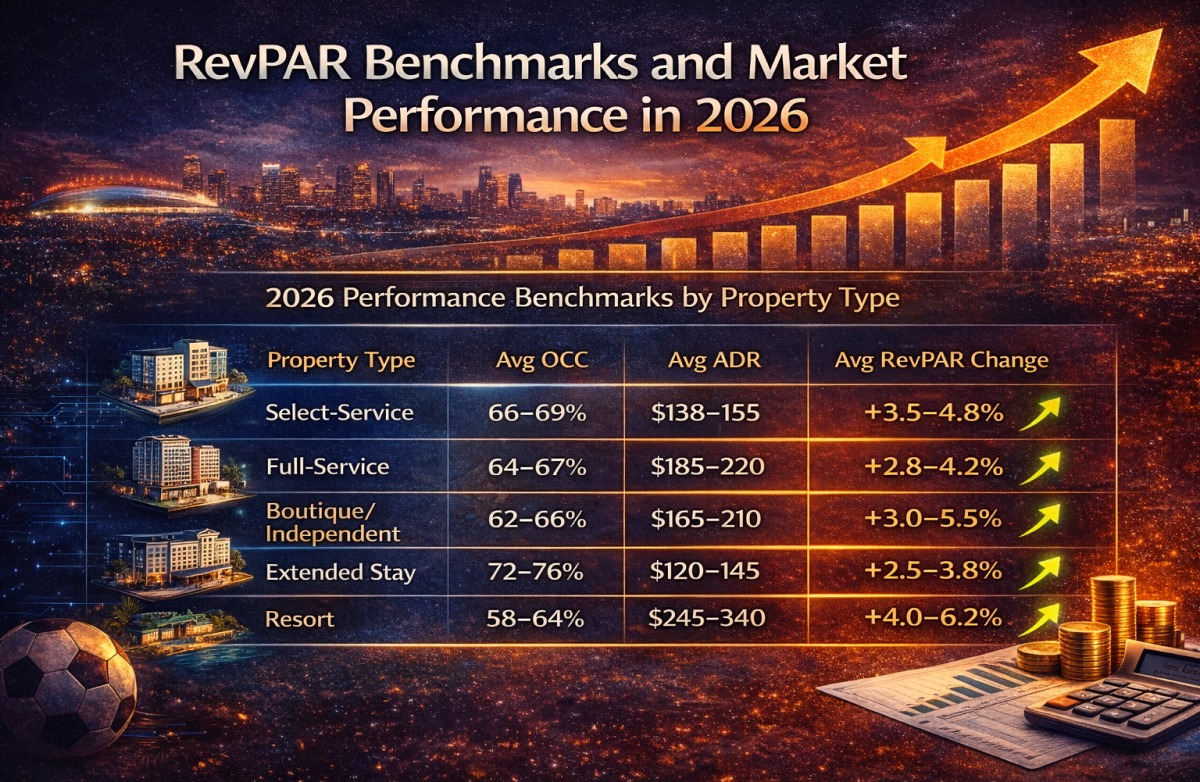
Where does hotel performance stand heading into 2026? The picture is nuanced. National RevPAR has grown 3–5% year-over-year for most segments, driven primarily by ADR gains rather than occupancy increases. Occupancy has largely plateaued in the 63–66% range nationally, meaning further RevPAR growth depends almost entirely on rate optimization.
This reality makes pricing precision more critical than ever. When occupancy is relatively flat, every dollar of ADR improvement drops directly to the bottom line. Hotels with active, data-driven RM programs are capturing that ADR upside. Hotels without it are watching their comp sets pull ahead.
2026 Performance Benchmarks by Property Type
| Property Type | Avg OCC | Avg ADR | Avg RevPAR | YoY RevPAR Change |
|---|---|---|---|---|
| Select-Service | 66–69% | $138–155 | $91–107 | +3.5–4.8% |
| Full-Service | 64–67% | $185–220 | $118–147 | +2.8–4.2% |
| Boutique/Independent | 62–66% | $165–210 | $102–139 | +3.0–5.5% |
| Extended Stay | 72–76% | $120–145 | $86–110 | +2.5–3.8% |
| Resort | 58–64% | $245–340 | $142–218 | +4.0–6.2% |
Source: Industry benchmarks compiled from STR, AHLA, and major brand performance reports. Ranges reflect U.S. market averages.
The most notable trend within these benchmarks: independent and boutique hotels are showing the widest performance variance. The top quartile of independents is outperforming some branded select-service properties, while the bottom quartile lags significantly. The differentiator? Access to (and use of) revenue management technology and expertise.
The Challenges That Still Hold Hotels Back from RM Excellence
Despite the technological progress, several persistent challenges continue to hold hotels back from realizing the full potential of modern revenue management.
Challenge 1: The talent gap is widening. Experienced revenue managers remain scarce and expensive. Annual RM salaries now range from $65,000–$95,000 depending on market and experience level, and demand outstrips supply in most major markets. This scarcity forces many independent hotels to operate without dedicated RM support-or to rely on general managers wearing too many hats.
Challenge 2: Data fragmentation persists. While the consolidation trend is real, 43% of hotels still operate with three or more disconnected RM-related systems, according to recent hospitality technology surveys. PMS data lives in one place, rate shopping in another, and the RM’s analysis in a spreadsheet. This fragmentation slows decisions and creates blind spots.
Challenge 3: Adoption inertia. Many hotel organizations recognize the value of AI-powered RM tools but struggle with adoption. Common objections include implementation complexity, integration concerns with existing PMS systems, and uncertainty about ROI timelines. The data, however, is clear: well-implemented AI RM platforms typically achieve payback within 1–3 months and deliver 8–15% RevPAR improvement within the first six months.
Challenge 4: Mega-event pricing uncertainty. With FIFA World Cup 2026 approaching across 16 host cities in the U.S., Mexico, and Canada, hotels face unprecedented demand forecasting challenges. Historical data from Russia 2018 and Qatar 2022 provides some guidance, but the scale and geographic spread of this tournament is unlike anything the industry has seen. Hotels in host cities need real-time demand intelligence and agile pricing strategies that traditional approaches simply cannot deliver.
How Modern BI Platforms Are Addressing These Challenges
The trends and challenges outlined above point to a clear need: hotels require unified, AI-powered platforms that consolidate forecasting, competitive intelligence, dynamic pricing, and daily workflow automation into a single system accessible to properties of all sizes.
This is precisely the approach behind platforms like RevEVOLVE, which brings together an AI demand forecasting engine with 94% accuracy, real-time competitive rate intelligence, what-if pricing simulation, and an AI copilot called RM Copilot that delivers automated daily briefings, conversational analytics, and proactive pricing signals. For RMCs and management companies, the platform includes portfolio-level dashboards and automated owner reporting that directly address the operational leverage challenge.
Whether you’re an independent hotel looking for enterprise-grade RM capabilities at an accessible price point, an RMC seeking to scale beyond the linear hiring model, or a management company standardizing workflows across a growing portfolio-the solutions are now available to match every operational model and growth stage.
The Bottom Line: What 2026 Demands from Every Revenue Leader
Hotel revenue management in 2026 is no longer about whether to adopt AI-it’s about how fast you can integrate it into your decision-making workflow. The three defining shifts-AI forecasting precision, platform consolidation, and copilot-assisted daily operations-are creating a widening performance gap between hotels that embrace these tools and those that don’t.
The properties and RM companies winning in 2026 share a common thread: they’ve stopped treating technology as an expense and started treating it as the primary lever for revenue growth and operational scale. With RevPAR improvements of 8–15%, time savings of 15+ hours per week, and the ability to manage 2–3x more properties per RM, the ROI case is no longer theoretical-it’s proven.
In our next blog, we’ll take a deep dive into how AI demand forecasting actually works-the signals, the models, and the accuracy benchmarks that separate leading platforms from the rest.
Frequently Asked Questions(FAQs)
Hotel revenue management is the practice of using data and analytics to predict demand, optimize pricing, and maximize revenue per available room (RevPAR). In 2026, it matters more than ever because occupancy growth has plateaued nationally at 63–66%, meaning further revenue growth depends primarily on pricing precision. Hotels with active, AI-assisted revenue management programs are achieving 8–15% higher RevPAR than those using manual methods alone.
Modern AI demand forecasting engines achieve 90–94% accuracy at 30 days out, compared to 70–75% for manual methods and 80–85% for basic rule-based RMS systems. This accuracy is achieved through ensemble models that blend multiple data signals including OTB pickup, historical patterns, market events, competitive rates, and booking velocity. The accuracy improves further for properties with 12+ months of historical data.
The five biggest hotel revenue management trends in 2026 are: (1) AI-powered demand forecasting becoming the new baseline with 90%+ accuracy, (2) consolidation of fragmented RM tools into unified BI platforms, (3) AI copilots handling 60–70% of daily RM workflows, (4) RevPAR growth driven by ADR optimization rather than occupancy gains, and (5) the upcoming FIFA World Cup 2026 creating unprecedented demand forecasting challenges across 16 host cities.
AI-powered revenue management platforms for hotels range from $299–$500+ per month for individual properties, with volume discounts for RMCs and management companies managing multiple hotels. Implementation typically takes 2–4 weeks. Well-implemented platforms achieve payback within 1–3 months and deliver 8–15% RevPAR improvement within six months, making the ROI case compelling for most properties.
No. AI is designed to amplify revenue managers, not replace them. AI automates the repetitive 60–70% of RM work-data aggregation, rate shopping, report generation, and routine monitoring-so revenue managers can focus on the strategic 20–30% that drives 80% of revenue impact. The most effective RM operations in 2026 combine AI precision for data processing with human judgment for strategic pricing, owner communication, and market interpretation.