In today’s competitive hospitality landscape, guest feedback is more than just a reflection of a stay. It’s a strategic asset. Revenue managers who understand how sentiment influences pricing, positioning, and perceived value can unlock significant commercial gains.
In this blog, we explore two powerful widgets from the RevEVOLVE.ai platform Price–Quality Insights and Sentimental Review Analysis and how they help hoteliers make informed, data-backed decisions. Designed with real-world hotel performance in mind, these tools bridge the gap between guest perception and revenue strategy.
Price–Quality Insights: Understanding Your Competitors Through Guest Ratings and Price Positioning
In today’s dynamic hospitality environment, pricing is no longer driven by market demand alone. It is shaped equally by guest-perceived value. The Price–Quality Insights widget provides a sophisticated, real-time view of how each property in the competitive set positions itself based on rate strategy and quality delivered.
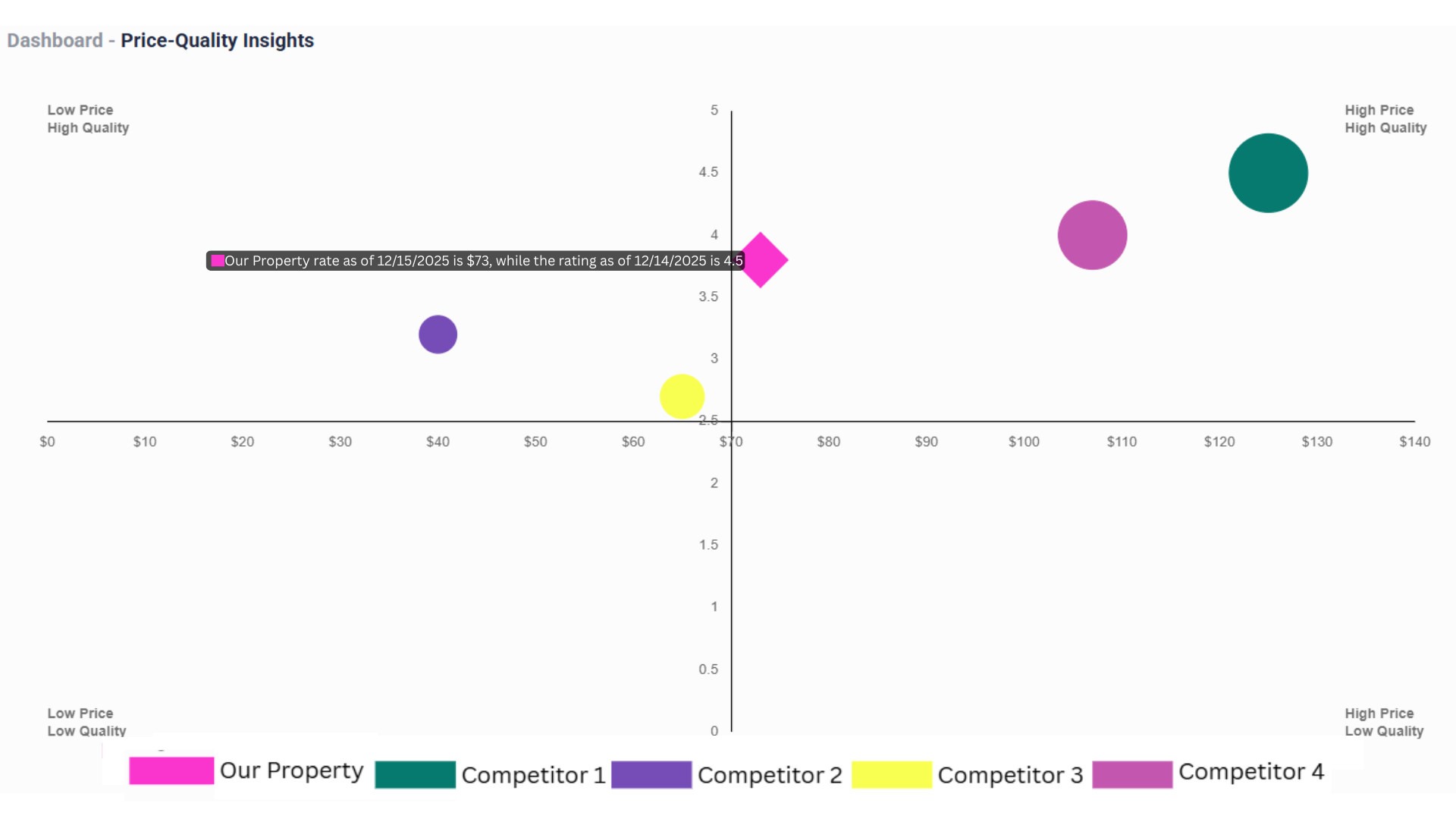
The Price–Quality Insights widget provides one of the most powerful visualizations for revenue managers: a direct comparison of how every property in the market is positioned based on price and guest-rated quality. This view goes far beyond traditional competitive benchmarking by combining ADR (Average Daily Rate) with guest sentiment–derived quality scores, creating a true “value map” of the marketplace.
At its core, the chart plots each property as a bubble on a two-axis graph:
- X-axis: Price (ADR) for the selected date
- Y-axis: Guest Rating (a measure of perceived quality)
By evaluating price and quality simultaneously, revenue managers can immediately identify whether a property is seen as overpriced, underpriced, high-value, or low-value.
Price Meets Real Guest Experience
- The property’s average rate for the selected day
- The guest rating associated with the most recent review
- The review date, showing when the sentiment was captured
This interaction is critical because it connects real customer feedback with market pricing. Instead of relying purely on competitor rate data, revenue managers can now see why a hotel is priced the way it is or whether the pricing strategy is misaligned with guest perception.
What This Means for Revenue Managers
1.Identify True Value Positioning
The widget helps determine where each property stands in terms of “value for money.” For example:
- A property with high ratings and moderate pricing reflects strong perceived value and potential for rate growth.
- A property with high pricing but average or weak ratings may be vulnerable to losing market share.
This applies equally to your property and your competitors, allowing a full-market understanding of where opportunities and risks lie.
2. Validate or Adjust Your Own Pricing Strategy
Because your hotel is plotted alongside competitors, this tool highlights whether you are:
- Underpricing despite strong guest satisfaction
- Overpricing compared to competitors with similar or better ratings
- Perfectly aligned with market expectations
This intelligence empowers revenue managers to refine rate strategies based on evidence, not assumptions.
3. Understand Market Dynamics at a Glance
Clusters and outliers in the chart reveal key competitive patterns:
- Are many competitors offering higher-priced stays with lower perceived quality?
- Is the market trending toward value-driven pricing?
- Are quality-leading hotels undercharging and capturing demand?
Seeing your hotel within this ecosystem helps anticipate shifts in booking behavior and competitive responses.
4. Leverage Sentiment as a Pricing Trigger
Because the chart uses sentiment-driven ratings, any recent change in guest satisfaction immediately impacts how the property appears on the graph.
For example:
- A recent spike in positive reviews may justify a tactical rate increase.
- A negative review trend may indicate a need for temporary rate protection or operational improvement before pushing rates.
This creates a dynamic, sentiment-aware pricing model that adapts in real time to evolving guest perception.
Sentimental Review Analysis: Understanding Guest Emotions Across the Competitive Set
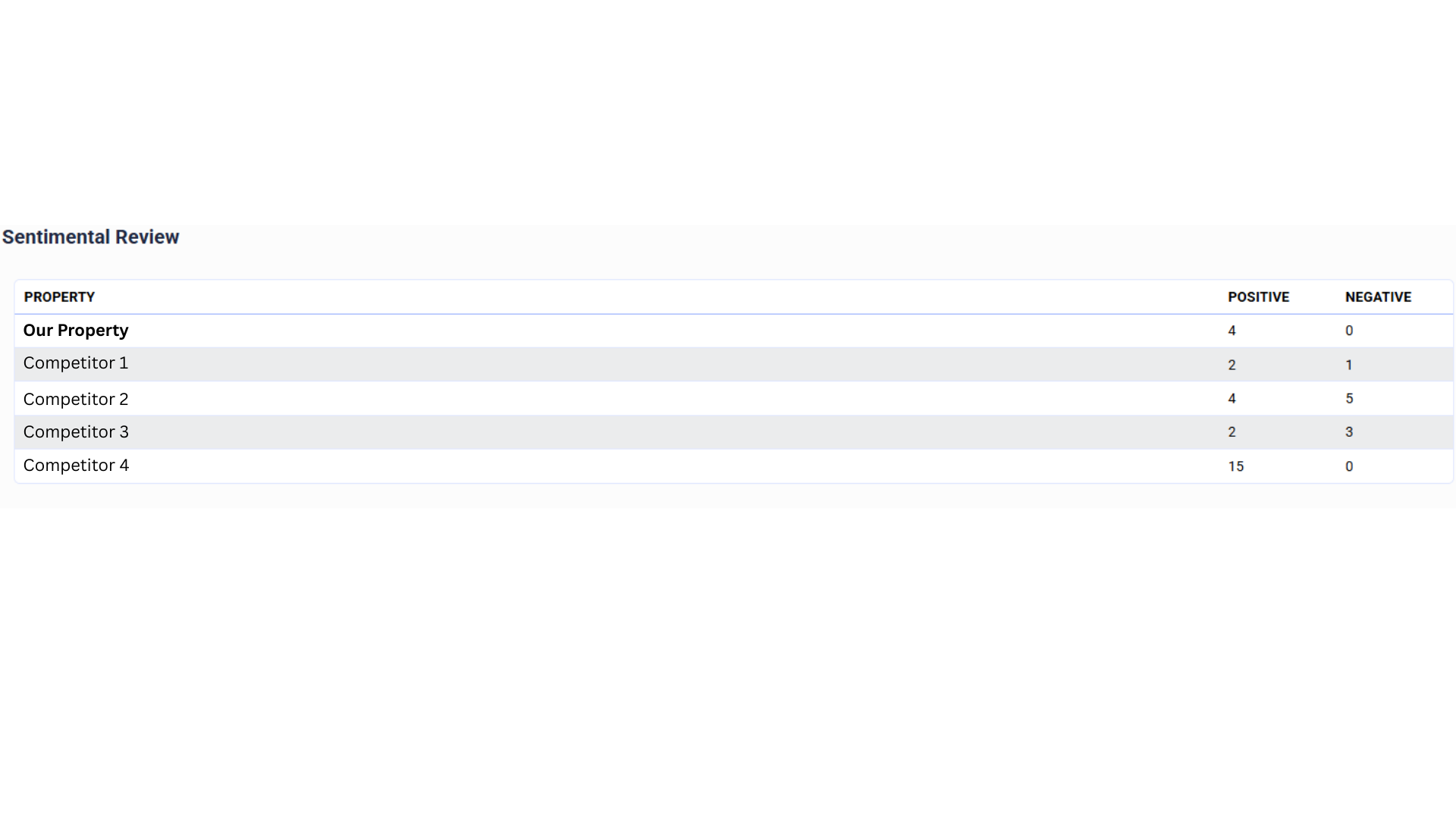
While traditional review scores tell us how satisfied guests are, they do not reveal how guests feel the emotions, tone, and intentions behind the feedback. The Sentimental Review Analysis widget bridges this gap by breaking reviews into two powerful components:
Positive Sentiment
Negative Sentiment
This gives revenue managers a deeper understanding of not just what guests rated, but why they rated it that way.
The table presents a clear comparison of your property and your competitive set, showing how many positive and negative reviews each hotel has received over a given period.
Why Sentiment Analysis Matters More Than Ever
In today’s digital-first travel environment, guests rely heavily on emotional cues in reviews before making booking decisions. A single negative comment can outweigh dozens of positive ones if the sentiment is strong.
For revenue managers, this means sentiment is directly tied to demand, price elasticity, and conversion probability.
Sentiment data helps answer critical commercial questions:
- Are guests emotionally satisfied with our product?
- Do competitors struggle with consistent service issues?
- Which properties pose a real threat in the market, based on guest happiness?
- How many reviews reflect delight, frustration, or dissatisfaction?
This insight goes far beyond star ratings or overall scores.
Deep Insights Provided by the Widget
1. Clear View of Emotional Performance Across the Market
Each property is evaluated not just on the number of reviews but on the tone of those reviews.
For example, a hotel with a moderate rating but consistently positive sentiment may be viewed more favorably than a hotel with higher ratings but frequent negative emotional feedback.
This helps identify:
- Properties that delight guests
- Properties showing signs of service fatigue
- Properties with chronic issues such as cleanliness, maintenance, or staff inconsistency
- Your hotel’s emotional positioning compared to the market
2. Early Warning System for Service and Experience Issues
Negative sentiment is often the first indicator of an operational problem.
A rise in negative reviews can signal:
- Guest dissatisfaction with a specific service point
- Staff performance issues
- Maintenance failures
- Poor check-in/check-out experience
- Decline in product quality
Because sentiment captures emotion, it reflects problems faster than average ratings. This allows hotels to act before issues impact occupancy or ADR.
3. Balanced Evaluation: Not Just Volume, but Quality of Reviews
The widget avoids the trap of simply counting reviews. A hotel with many reviews is not necessarily stronger than a hotel with fewer but overwhelmingly positive reviews.
The breakdown helps understand:
- Review quantity (how many guests are talking)
- Review quality (what guests are actually saying)
- Emotional direction (delight vs. dissatisfaction)
- Consistency (whether guest experience fluctuates)
This enables a multi-dimensional interpretation of the guest experience.
Turning Guest Perception Into Revenue Power
Together, the Price–Quality Insights and Sentimental Review Analysis widgets create a complete, intelligence-driven framework for modern hotel revenue management. One reveals how the market perceives value, while the other uncovers why guests feel the way they do. When used together, these tools give revenue managers a deeper level of clarity not just about pricing and demand, but about emotional drivers, service gaps, and competitive positioning.
They help you answer the questions that truly matter:
- Are we priced in alignment with the experience we deliver?
- Do guests feel positively enough about our product to support stronger pricing?
- Where do competitors fall short, and how can we capture that opportunity?
- Are we responding quickly enough to shifts in guest sentiment?
By integrating sentiment intelligence with pricing insights, hoteliers can design strategies that are not just reactive but proactive, anticipating demand changes, adjusting pricing with confidence, and enhancing service quality to strengthen long-term performance.
In an industry where guest expectations evolve rapidly and online reputation influences every booking decision, the ability to interpret both data and emotion becomes a serious competitive advantage. Hotels that leverage these insights consistently outperform those that rely solely on traditional metrics.
Ultimately, guest perception is the new currency of revenue management.
And with tools that translate emotion into actionable strategy, you gain the power to optimize pricing, elevate guest experience, and drive sustainable revenue growth all while staying one step ahead in a highly competitive market.