A Comprehensive Playbook for Revenue Management Companies to Onboard, Educate, and Empower Clients with RevEVOLVE BI Platform
In today’s hyper-competitive hospitality landscape, Revenue Management Companies (RMCs) are evolving beyond traditional consulting services. Clients no longer just want advice-they want tools, transparency, and the ability to make data-driven decisions in real-time. RevEVOLVE, a cutting-edge Revenue Management Business Intelligence platform, represents a transformative opportunity for RMCs to elevate their value proposition and deliver unprecedented insights to their hotel and property management clients.
However, successfully integrating RevEVOLVE into your service offering requires more than just licensing the software. It demands a strategic approach to onboarding, education, change management, and continuous support. This comprehensive guide provides a detailed playbook for Revenue Management Companies looking to adopt RevEVOLVE as a core component of their client services, ensuring smooth implementation, high adoption rates, and maximum value realization.
1. Understanding RevEVOLVE: Platform Overview and Value Proposition
What is RevEVOLVE?
Before rolling out RevEVOLVE to your clients, ensure your team has a deep understanding of the platform’s capabilities and how it complements your existing revenue management services.
- Comprehensive BI dashboards: Real-time visualization of revenue metrics, KPIs, occupancy trends, rate positioning, and market performance.
- Advanced analytics: Predictive forecasting, demand modeling, competitive benchmarking, and price optimization insights.
- Integration capabilities: Seamless connection with PMS, RMS, CRS, channel managers, and STR data sources.
- Customizable reporting: Automated daily, weekly, and monthly reports tailored to different stakeholder needs (owners, GMs, revenue managers).
- Mobile accessibility: Cloud-based platform accessible from any device, enabling decision-making on the go.
The RMC Value Proposition with RevEVOLVE
Position RevEVOLVE as an enhancement to your core services, not a replacement. Articulate clearly how it amplifies your value:
- 24/7 access to insights: While your team provides strategic guidance, RevEVOLVE gives clients continuous visibility into their performance between consulting touchpoints.
- Data-driven collaboration: Shared dashboards create a common language and reference point for strategic discussions with your clients.
- Scalability: Enables your RMC to serve more properties effectively by automating reporting and data aggregation tasks.
- Competitive differentiation: Sets you apart from RMCs offering only traditional consulting without technology enablement.
- Client empowerment: Helps clients develop their own revenue management capabilities while still relying on your expertise for strategy and optimization.
2. Internal Preparation: Building RevEVOLVE Expertise Within Your RMC
Designate RevEVOLVE Champions
Create a core team within your RMC who will become platform experts and drive adoption:
- Platform administrator: Technical point person responsible for system configuration, integrations, and troubleshooting.
- Training lead: Someone who will develop educational materials and lead client training sessions.
- Client success manager: Owns the onboarding process and ongoing client engagement with the platform.
- Revenue management consultants: Your frontline team who will use RevEVOLVE as a tool in their daily client interactions.
Master the Platform Internally First
Before introducing RevEVOLVE to any client, ensure your entire team is thoroughly trained and comfortable with the platform:
- Complete vendor training: Participate in all RevEVOLVE onboarding and certification programs offered by the platform provider.
- Internal pilot: Use RevEVOLVE to analyze your existing client portfolio for 30-60 days before rolling out to clients.
- Document best practices: Create internal guides on how to extract maximum value from different dashboard views, reports, and analytics features.
- Develop use cases: Build a library of scenarios showing how RevEVOLVE insights lead to actionable revenue management decisions.
- Create troubleshooting resources: Compile common issues and their solutions to enable quick client support.
Customize Your Service Packages
Design tiered service offerings that incorporate RevEVOLVE at different levels:
- Essential package: RevEVOLVE access with standard dashboards, monthly strategy calls, and email support.
- Professional package: Everything in Essential plus custom dashboard configuration, weekly check-ins, and priority support.
- Premium package: Fully managed service with dedicated revenue manager, daily monitoring, custom reporting, and on-site training.
- Enterprise package: Multi-property portfolios with consolidated reporting, advanced analytics, and strategic planning sessions.
Prepare Your Implementation Toolkit
Develop standardized resources that will streamline client onboarding:
- Implementation checklist: Step-by-step guide covering data integration, user setup, dashboard configuration, and go-live criteria.
- Training materials: PowerPoint presentations, video tutorials, quick reference guides, and FAQ documents.
- Templates and examples: Sample dashboards, report templates, and KPI frameworks tailored to different property types.
- Communication templates: Email sequences for onboarding announcements, training invitations, and ongoing engagement.
- Success metrics: Framework for measuring adoption, engagement, and business impact of RevEVOLVE deployment.
3. Client Segmentation and Rollout Strategy
Segment Your Client Portfolio
Not all clients will adopt RevEVOLVE at the same pace or with the same level of engagement. Strategic segmentation enables targeted rollout approaches:
- Tech-forward early adopters: Properties with existing BI tools or strong analytics capabilities-ideal for pilot programs and testimonials.
- Growth-focused clients: Properties actively seeking to optimize revenue with strong buy-in from ownership and management.
- Traditional operators: Properties comfortable with manual processes-require more education and change management support.
- Multi-property portfolios: Management companies or ownership groups operating multiple assets-need consolidated views and standardized processes.
- New client acquisitions: Incorporate RevEVOLVE from day one as part of your standard service offering.
Phased Rollout Approach
Deploy RevEVOLVE in waves to manage resources effectively and learn from each cohort:
- Wave 1 – Pilot (3-5 properties): Select diverse property types and client relationships. Use this phase to refine your onboarding process and materials.
- Wave 2 – Early majority (15-20% of portfolio): Expand to clients who have expressed interest or have the greatest need for enhanced analytics.
- Wave 3 – Broad deployment (50-60% of portfolio): Roll out to all clients in your core service tiers over 3-6 months.
- Wave 4 – Remaining clients: Address any holdouts, evaluate opt-out situations, and consider whether RevEVOLVE should become mandatory for all engagements.
Communicate the Value Proposition
When introducing RevEVOLVE to clients, frame it around outcomes they care about, not technical features:
- “See your revenue performance in real-time”: Emphasize immediate visibility into occupancy, ADR, RevPAR, and pickup trends without waiting for monthly reports.
- “Benchmark against your competitive set instantly”: Highlight the ability to track market share and position versus competitors on demand.
- “Make faster, more confident decisions”: Show how data-driven insights reduce guesswork in pricing and inventory management.
- “Align your entire team around the same data”: Demonstrate how shared dashboards create consistency between GMs, revenue managers, sales teams, and ownership.
- “Spend less time reporting, more time strategizing”: Emphasize automation of routine reporting so leadership can focus on high-value activities.
4. The Onboarding Process: Step-by-Step Implementation
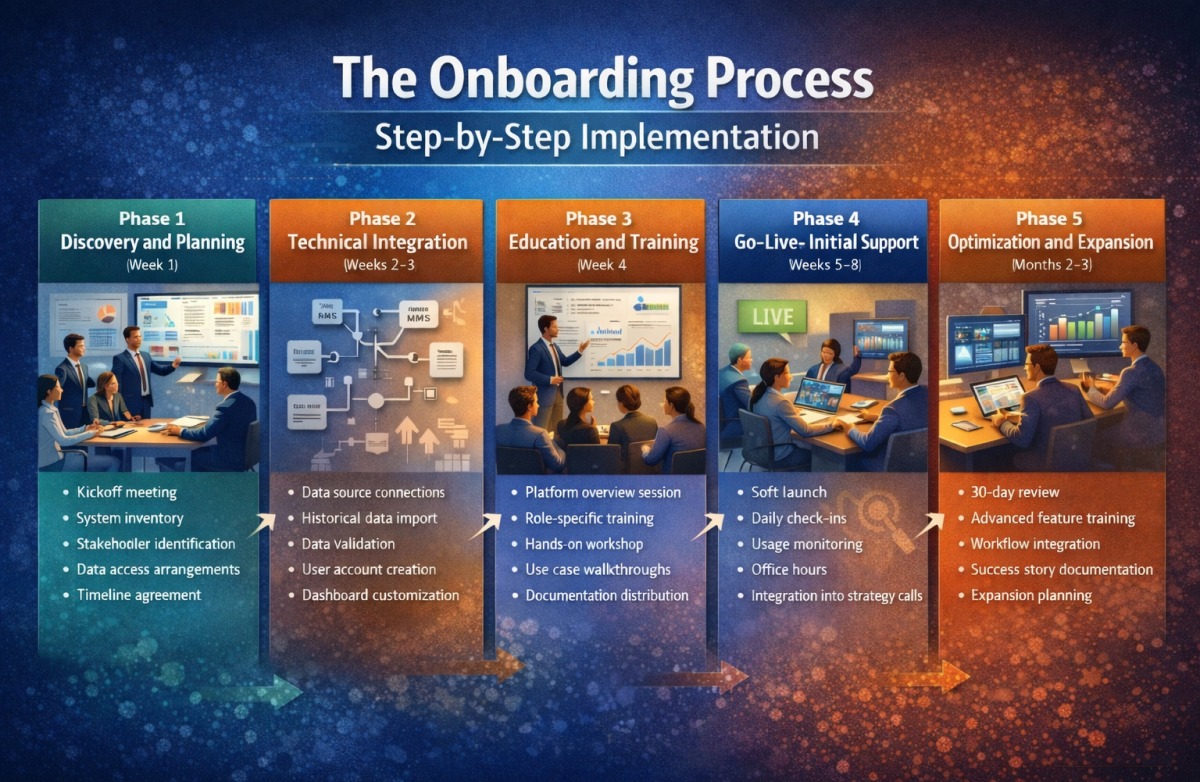
Phase 1: Discovery and Planning (Week 1)
- Kickoff meeting: Introduce RevEVOLVE capabilities, discuss client objectives, set expectations, and establish success criteria.
- System inventory: Document current technology stack (PMS, RMS, channel manager, CRS) and identify integration requirements.
- Stakeholder identification: Determine who needs access (revenue managers, GMs, sales directors, owners) and define their permission levels.
- Data access arrangements: Obtain necessary credentials, API keys, and approvals for connecting RevEVOLVE to data sources.
- Timeline agreement: Establish realistic milestones for integration, testing, training, and go-live.
Phase 2: Technical Integration (Weeks 2-3)
- Data source connections: Configure integrations with PMS, RMS, STR, and other relevant systems.
- Historical data import: Load 12-24 months of historical performance data to enable trend analysis and forecasting.
- Data validation: Verify accuracy of imported data by cross-referencing with existing reports and reconciling any discrepancies.
- User account creation: Set up individual logins with appropriate role-based permissions for all identified stakeholders.
- Dashboard customization: Configure standard dashboards and create custom views aligned with client’s specific KPIs and reporting needs.
Phase 3: Education and Training (Week 4)
- Platform overview session: 60-90 minute introduction covering navigation, key features, and basic functionality for all users.
- Role-specific training: Targeted sessions for different user types (revenue managers get deep dives into analytics, while owners focus on executive dashboards).
- Hands-on workshop: Interactive session where users practice accessing reports, customizing views, and interpreting data with guidance.
- Use case walkthroughs: Demonstrate specific scenarios like identifying pickup issues, analyzing segment performance, or evaluating rate strategy effectiveness.
- Documentation distribution: Provide quick start guides, video tutorials, and FAQ resources for ongoing reference.
Phase 4: Go-Live and Initial Support (Weeks 5-8)
- Soft launch: Enable access for all users with heightened support availability during the first week.
- Daily check-ins: Brief calls or emails during the first week to address questions, troubleshoot issues, and reinforce training concepts.
- Usage monitoring: Track login frequency, dashboard views, and report downloads to identify engagement levels and potential training gaps.
- Office hours: Offer scheduled drop-in sessions where users can ask questions and get personalized guidance.
- Integration into strategy calls: Begin incorporating RevEVOLVE dashboards into your regular client meetings, modeling how to use the platform for strategic discussions.
Phase 5: Optimization and Expansion (Months 2-3)
- 30-day review: Assess adoption metrics, gather user feedback, and identify additional customization opportunities.
- Advanced feature training: Introduce more sophisticated capabilities like custom report building, automated alerts, and predictive analytics.
- Workflow integration: Help client embed RevEVOLVE into daily routines (morning revenue meetings, weekly forecasting sessions, monthly strategy reviews).
- Success story documentation: Capture specific examples of how RevEVOLVE insights led to revenue-positive decisions.
- Expansion planning: Identify additional users who could benefit from access or supplementary modules/features to add value.
5. Educational Framework: Building Client Competency
Multi-Modal Learning Approach
Different clients learn in different ways. Provide education through multiple channels:
- Live training sessions: Interactive webinars or on-site workshops for hands-on learning and immediate Q&A.
- Video tutorials: Short (3-5 minute) recorded videos demonstrating specific tasks, accessible on-demand for just-in-time learning.
- Written documentation: Comprehensive user guides, one-page quick references, and annotated screenshots for detailed self-study.
- Practice environment: Sandbox or demo account where users can explore without affecting real data.
- Certification program: Optional structured learning path with assessments to validate competency and recognize power users.
Core Curriculum Topics
Structure your educational content around these essential competencies:
- Fundamentals: Platform navigation, dashboard basics, understanding key metrics, and interpreting visualizations.
- Performance monitoring: Daily pickup analysis, pace reporting, occupancy tracking, and ADR/RevPAR trending.
- Competitive intelligence: Market share analysis, STR benchmarking, rate shopping insights, and positioning strategies.
- Forecasting and budgeting: Understanding predictive models, scenario planning, and variance analysis.
- Segment analysis: Evaluating channel performance, booking source contribution, and guest segment profitability.
- Reporting and communication: Creating custom reports, scheduling automated distributions, and presenting insights to stakeholders.
- Advanced analytics: Custom calculations, correlation analysis, and leveraging AI-powered recommendations.
Continuous Learning Program
Education doesn’t end after initial onboarding. Create an ongoing learning ecosystem:
- Monthly webinar series: Cover rotating topics like seasonal forecasting, group business optimization, or emerging market trends.
- Quarterly power user roundtables: Bring together experienced RevEVOLVE users to share best practices and advanced techniques.
- Platform update communications: Proactively notify clients of new features, enhancements, and optimization tips.
- Use case library: Maintain a growing repository of real-world examples showing how RevEVOLVE insights drove specific results.
- Office hours and drop-in support: Regular scheduled times when clients can get help, ask questions, or request custom guidance.
Tailored Training by Role
Recognize that different stakeholders need different levels of depth and focus:
- Revenue managers: Deep technical training on all analytical features, forecasting tools, and optimization capabilities.
- General managers: Focus on executive dashboards, KPI interpretation, and how to have data-driven conversations with ownership.
- Owners and asset managers: High-level performance monitoring, ROI tracking, and comparative portfolio analysis.
- Sales directors: Emphasis on group pace, segment performance, and booking pattern analysis.
- Front office managers: Real-time occupancy tracking, arrival forecasting, and operational insights.
6. Driving Adoption and Engagement
Overcome Resistance to Change
Anticipate and proactively address common objections and concerns:
- “We’re already too busy”: Demonstrate how RevEVOLVE actually saves time by automating manual reporting and consolidating data from multiple sources.
- “Our existing reports work fine”: Show the limitations of static reports versus dynamic, interactive dashboards with drill-down capabilities.
- “This looks complicated”: Start with simplified views and gradually introduce complexity as users build confidence.
- “We tried a BI tool before and it didn’t work”: Acknowledge past experiences and explain what makes RevEVOLVE different, especially with your RMC guidance.
- “I don’t trust the data”: Walk through the data validation process and show how to verify accuracy through cross-referencing.
Create Adoption Incentives
Make using RevEVOLVE the path of least resistance and most benefit:
- Integrate into existing workflows: Reference RevEVOLVE dashboards in every strategy call, making it the primary data source for discussions.
- Gamification elements: Recognize power users, celebrate milestones (100th login, first custom report created), and highlight success stories.
- Executive visibility: Ensure ownership and senior leadership actively use and reference the platform, setting an example from the top.
- Reduce alternatives: Phase out duplicative manual reports you previously provided, directing clients to RevEVOLVE for that information.
- Quick wins: Identify and highlight early successes where RevEVOLVE insights directly led to positive revenue outcomes.
Monitor and Measure Adoption
Track these key indicators to assess engagement and identify intervention needs:
- Login frequency: What percentage of users access the platform weekly? Daily? (Target: 80% weekly active users)
- Dashboard views: Which dashboards get the most use? Which are ignored? (Indicates training needs or configuration issues)
- Report generation: How often are custom reports created? Are users leveraging automation? (Target: 50% of users create at least one custom report monthly)
- Support requests: Declining support volume indicates growing competency; sustained high volume suggests training gaps.
- Feature utilization: Are advanced capabilities being used, or are users stuck on basic views? (Signals need for progressive training)
Proactive Engagement Tactics
Don’t wait for clients to come to you-actively drive usage through strategic touchpoints:
- Weekly insight emails: Send brief messages highlighting interesting trends visible in their dashboards with direct links to relevant views.
- Personalized recommendations: “Based on your recent pace, you might want to review the Group Business dashboard for next month.”
- Just-in-time tips: Send contextual guidance at strategic moments (e.g., forecasting tips at month-end, STR benchmarking advice when new data arrives).
- Challenge campaigns: “This week, try creating an alert for your busiest upcoming dates” with incentives for completion.
- Peer learning: Facilitate connections between high-adopting clients and those struggling, enabling knowledge sharing.
7. Support Infrastructure and Client Success Management
Multi-Tiered Support Model
Establish clear channels for different types of client needs:
- Tier 1 – Self-service: Comprehensive help center, video library, FAQs, and in-platform tooltips for common questions.
- Tier 2 – Standard support: Email and ticketing system for non-urgent issues, with 24-48 hour response commitment.
- Tier 3 – Priority support: Phone/video support for premium clients, same-day response for urgent issues.
- Tier 4 – Dedicated account management: Assigned success manager for enterprise clients with proactive check-ins and optimization consultations.
Common Support Scenarios and Solutions
Prepare your team to handle these frequent issues effectively:
- Data discrepancies: Step-by-step process for investigating and resolving differences between RevEVOLVE and PMS reports.
- Access and permission issues: Quick troubleshooting guide for login problems, password resets, and role adjustments.
- Integration failures: Protocols for identifying whether issues are PMS-side, RevEVOLVE-side, or connectivity-related.
- Report customization requests: Process for evaluating feasibility and either guiding self-service configuration or handling custom build.
- Training reinforcement: Identifying when repeated support requests indicate need for supplementary training rather than one-off fixes.
Proactive Client Success Management
Go beyond reactive support with proactive engagement focused on value realization:
- 30-60-90 day success reviews: Structured check-ins to assess progress, address challenges, and identify optimization opportunities.
- Health score monitoring: Track engagement metrics and flag at-risk clients for intervention before they disengage.
- Quarterly business reviews: Present utilization analytics, highlight value delivered, and plan next-phase enhancements.
- Success story documentation: Capture and communicate specific wins attributable to RevEVOLVE insights for internal validation and marketing.
- Expansion opportunities: Identify natural progression paths (adding users, enabling premium features, expanding to additional properties).
Build a Knowledge Base
Create comprehensive self-service resources that reduce support burden while empowering clients:
- Searchable help articles: Organized by topic and task, with screenshots and step-by-step instructions.
- Video tutorial library: Covering everything from basic navigation to advanced analytical techniques.
- Use case database: Real-world examples of how to apply RevEVOLVE to solve specific revenue management challenges.
- Best practices guides: Recommendations for dashboard configuration, alert setup, reporting cadences, and workflow integration.
- Troubleshooting flowcharts: Visual guides for diagnosing and resolving common issues independently.
8. Measuring ROI and Demonstrating Value
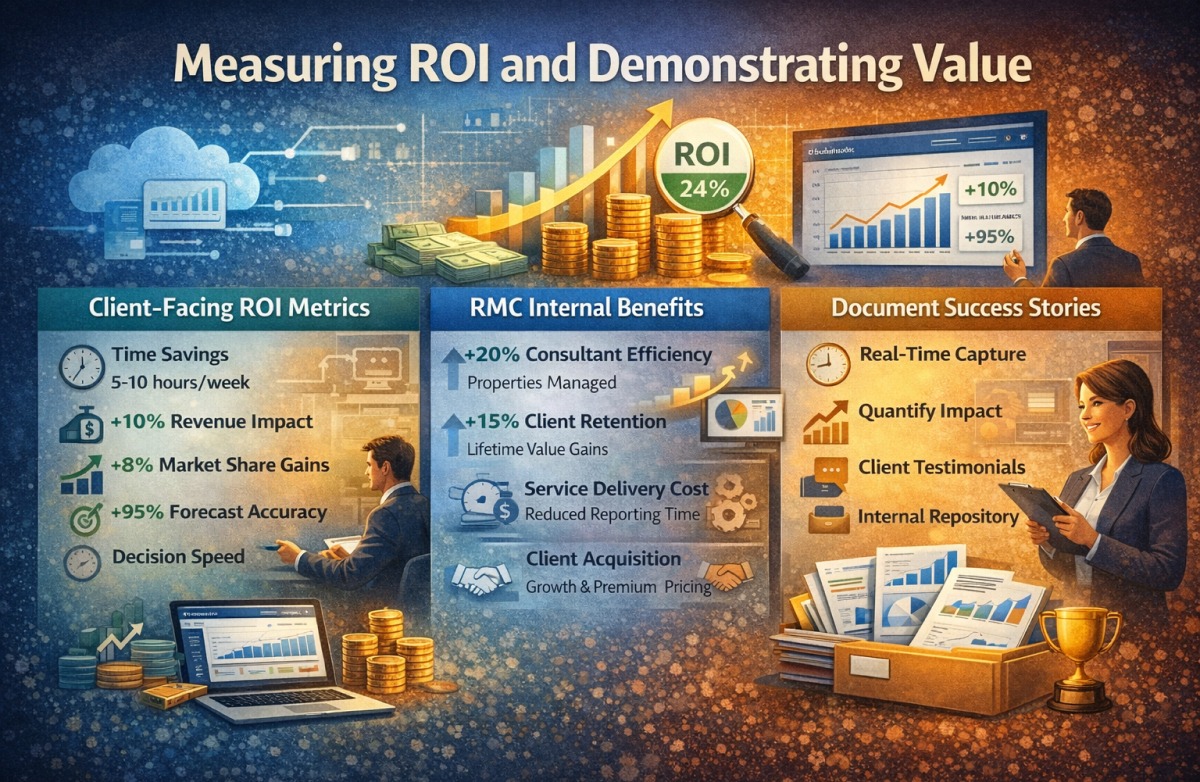
Client-Facing ROI Metrics
Help clients quantify the business impact of RevEVOLVE adoption through these measurements:
- Time savings: Hours reclaimed weekly from automated reporting versus manual spreadsheet compilation (Target: 5-10 hours per property per week).
- Revenue impact: Incremental revenue attributed to pricing optimizations, demand capture, or displacement strategies informed by RevEVOLVE insights.
- Market share gains: Improvement in STR penetration index or revenue penetration index over baseline period.
- Forecast accuracy: Reduction in variance between forecasted and actual performance, enabling better operational planning.
- Decision speed: Faster response to market changes due to real-time visibility (e.g., adjusting rates same-day versus waiting for weekly reports).
RMC Internal Benefits
Track these metrics to validate RevEVOLVE’s impact on your own business:
- Consultant efficiency: Properties managed per revenue manager increasing 15-25% due to automation and self-service capabilities.
- Client retention: RevEVOLVE as a differentiator reducing churn and increasing lifetime value of client relationships.
- Service delivery cost: Reduction in hours spent on report generation and basic data analysis, shifting focus to high-value strategic work.
- Client acquisition: RevEVOLVE-enabled services attracting new clients who specifically seek technology-forward partners.
- Premium pricing: Ability to command higher fees for technology-enhanced service packages versus traditional consulting-only offerings.
Document Success Stories
Create a systematic approach to capturing and communicating wins:
- Real-time capture: When a client reports a successful outcome influenced by RevEVOLVE, immediately document the details while fresh.
- Quantify impact: Work backward from the decision to calculate revenue impact, time saved, or competitive advantage gained.
- Client testimonials: Request permission to share anonymized or attributed success stories for marketing and education.
- Internal repository: Maintain searchable database of wins organized by property type, use case, and outcome to support future sales and training.
- Regular communication: Share relevant success stories with all clients to inspire ideas and demonstrate platform value.
9. Common Challenges and Solutions
Challenge 1: Data Quality and Integration Issues
Problem: Inaccurate or incomplete data undermines trust in the platform and leads to poor decisions.
Solutions:
- Thorough validation during setup: Cross-check RevEVOLVE data against PMS reports for multiple date ranges before declaring go-live.
- Clear data governance: Document data sources, update frequencies, and known limitations so users understand what they’re seeing.
- Regular audits: Monthly reconciliation between RevEVOLVE and source systems to catch and correct drift.
- Escalation path: Clear process for reporting suspected data issues with defined SLA for investigation and resolution.
Challenge 2: Low User Engagement After Initial Rollout
Problem: Users log in during training but then revert to old habits and tools.
Solutions:
- Embed in regular touchpoints: Reference RevEVOLVE dashboards in every client meeting, making it impossible to participate without using the platform.
- Reduce parallel systems: Discontinue legacy reports that duplicate RevEVOLVE functionality, forcing migration.
- Personalized re-engagement: Reach out individually to inactive users to understand barriers and provide targeted support.
- Gamification and recognition: Acknowledge active users, share their insights with peers, and create positive reinforcement loops.
Challenge 3: Over-Reliance on Technology Without Strategic Thinking
Problem: Clients treat RevEVOLVE as a black box that gives answers rather than a tool for informed decision-making.
Solutions:
- Emphasize interpretation: Train clients to ask “why” and “what if” questions about data, not just accept surface-level insights.
- Model critical thinking: Demonstrate your own analytical process during client calls, showing how you combine RevEVOLVE data with market knowledge and experience.
- Scenario planning exercises: Use RevEVOLVE to explore multiple strategies and their potential outcomes, reinforcing that technology supports (not replaces) judgment.
- Educational content: Share articles, webinars, and case studies that illustrate the importance of human expertise alongside data analytics.
Challenge 4: Resistance from Ownership or Senior Leadership
Problem: Decision-makers are skeptical of the value or reluctant to fund platform access for their properties.
Solutions:
- Executive-focused demos: Present tailored demonstrations showing high-level dashboards and ROI metrics relevant to their concerns.
- Pilot programs: Offer limited-term trial at one property to prove value before asking for portfolio-wide commitment.
- Competitive benchmarking: Share how RevEVOLVE adoption is becoming industry standard and the risks of falling behind competitors.
- ROI modeling: Present detailed financial analysis showing platform costs versus quantified benefits in revenue optimization and efficiency gains.
Challenge 5: Platform Overwhelm and Feature Paralysis
Problem: Too many features and dashboards lead to confusion about where to start and what to focus on.
Solutions:
- Phased feature introduction: Start with 3-4 core dashboards and only introduce additional capabilities after mastery of basics.
- Role-based defaults: Configure user accounts to show only relevant dashboards for their specific job function.
- Curated workflows: Create and document specific sequences (“Monday morning routine: check pickup dashboard → review pace report → adjust rates”).
- Simplified starter templates: Provide pre-configured dashboard layouts that can be customized later as sophistication grows.
10. Long-Term Success: Building a Culture of Data-Driven Decision Making
Evolve Your Service Model
As clients become proficient with RevEVOLVE, shift your RMC role to higher-value activities:
- From data provider to strategic advisor: Let RevEVOLVE handle routine reporting while you focus on interpretation, strategy, and complex problem-solving.
- From reactive to proactive: Use platform alerts and analytics to identify opportunities before clients ask, demonstrating continuous value.
- From generalist to specialist: Develop deep expertise in specific revenue management domains (e.g., group business optimization, distribution strategy) enabled by RevEVOLVE analytics.
- From individual properties to portfolio strategy: Leverage consolidated multi-property views to provide enterprise-level insights and cross-property optimization.
Foster a Learning Organization
Create environments where continuous improvement and knowledge sharing are embedded:
- User communities: Facilitate peer-to-peer learning through client roundtables, online forums, or annual user conferences.
- Innovation challenges: Encourage clients to develop creative uses for RevEVOLVE and share their innovations with the broader community.
- Center of excellence: Designate power users as champions who mentor others and beta test new features.
- Continuous feedback loop: Regularly solicit input on platform enhancements and advocate for client needs with RevEVOLVE product team.
Stay Current with Platform Evolution
Technology platforms continuously improve-ensure you and your clients evolve with them:
- Track product roadmap: Maintain close relationship with RevEVOLVE to understand upcoming features and plan client communications.
- Rapid adoption of new capabilities: Quickly learn and rollout new features to maintain competitive advantage and demonstrate ongoing value.
- Periodic platform audits: Annually review how clients use RevEVOLVE versus available capabilities, identifying expansion opportunities.
- Complementary tools: Evaluate and integrate adjacent technologies (AI forecasting, dynamic pricing engines) that enhance RevEVOLVE effectiveness.
Measure and Communicate Impact Continuously
Make value visible and concrete through ongoing measurement:
- Annual impact reports: Provide each client with comprehensive analysis of RevEVOLVE’s contribution to their performance versus prior year or budget.
- Real-time win tracking: Maintain a running log of decisions influenced by RevEVOLVE insights and their outcomes.
- Benchmark across portfolio: Show clients how their RevEVOLVE adoption and performance compares to similar properties in your managed portfolio.
- Public success stories: Selectively share anonymous case studies in marketing materials to attract new clients and reinforce value for existing ones.
Conclusion: RevEVOLVE as a Strategic Differentiator
The hospitality industry is undergoing a fundamental transformation in how revenue management is practiced. Properties that embrace data-driven decision-making powered by sophisticated BI platforms like RevEVOLVE will increasingly outperform those relying on traditional approaches. As a Revenue Management Company, your role is not just to deliver consulting expertise but to empower your clients with the tools and knowledge they need to compete effectively.
Successfully integrating RevEVOLVE into your service offering requires thoughtful planning, systematic execution, and sustained commitment to client success. It’s not a one-time implementation project but an ongoing journey of education, adoption, optimization, and innovation. The RMCs that will thrive in the coming years are those that position themselves as technology-enabled partners rather than traditional consultants combining deep revenue management expertise with cutting-edge analytics platforms.
RevEVOLVE represents more than just a software tool. It’s an opportunity to transform your client relationships, scale your service delivery, demonstrate continuous value, and differentiate your firm in an increasingly competitive market. By following the playbook outlined in this guide from internal preparation through onboarding, education, adoption, and long-term success management you can maximize the return on this investment for both your clients and your own business.
The most successful partnerships will be those where RMCs and their clients work together to leverage RevEVOLVE not as a replacement for strategic thinking but as an accelerator of it providing the data foundation, analytical horsepower, and operational efficiency that enables revenue managers to focus on what truly matters: making better, faster, more confident decisions that drive measurable revenue growth.
Start your RevEVOLVE journey today with clear objectives, comprehensive planning, and unwavering commitment to client success. The hotels and properties you serve are counting on you to guide them through this evolution and with the right approach, you’ll position yourself as an indispensable partner in their ongoing revenue optimization journey.
Partnership Guide for Revenue Management Companies: How to Successfully Integrate RevEVOLVE into Your Service Offering