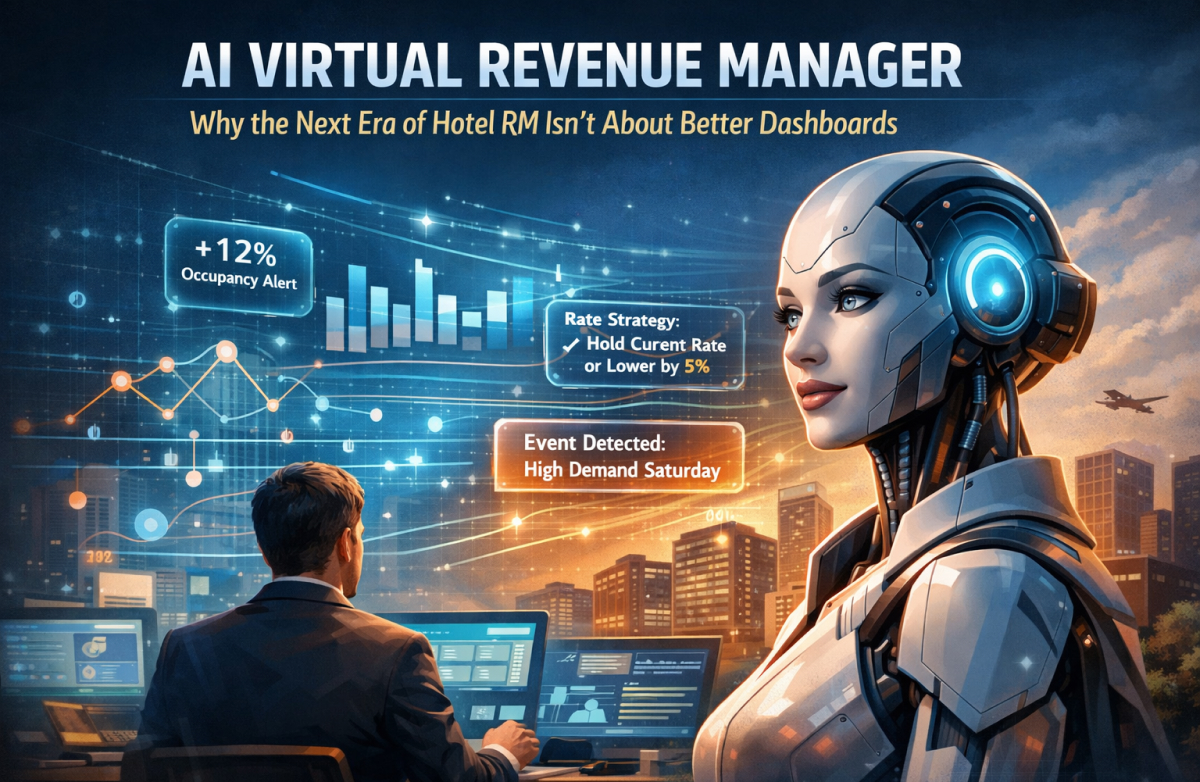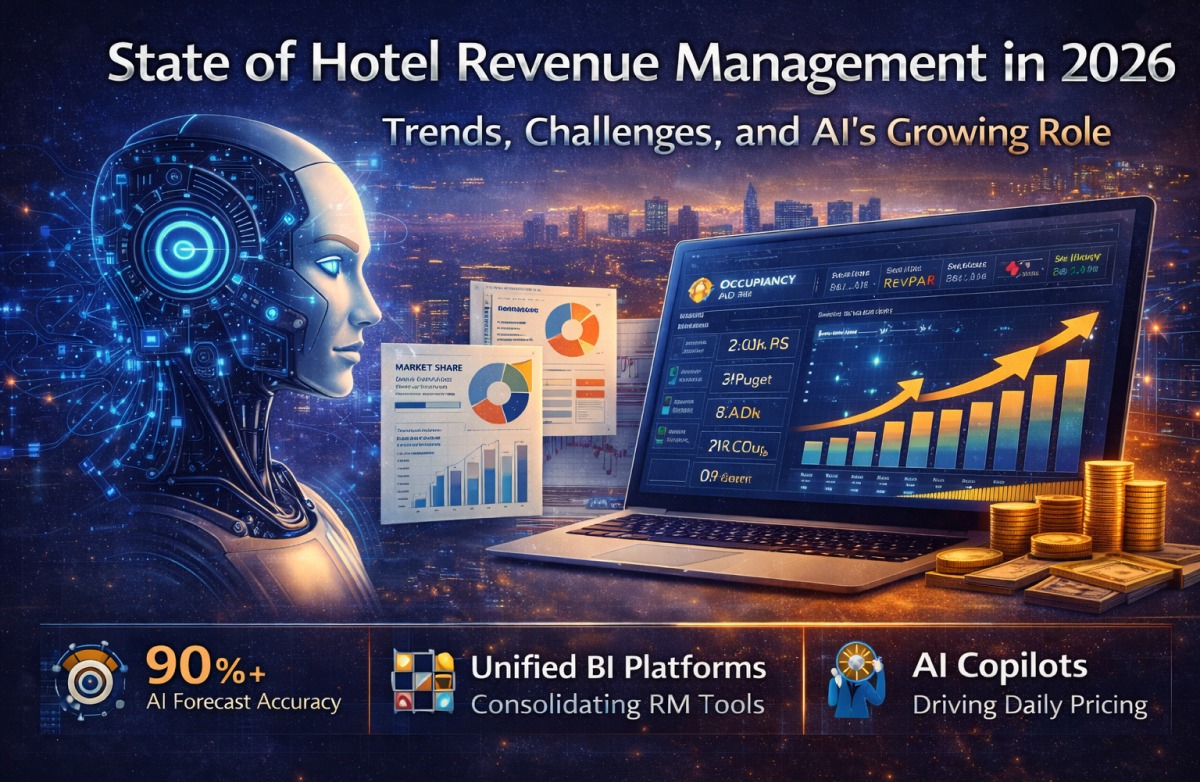
For years, revenue management meant spreadsheets, historical reports, and a constant race to keep up with your comp set. It was reactive, siloed, and often reserved for big brands with big budgets. But hospitality has changed. Traveler behavior has shifted. Booking patterns are less predictable. Margins are tighter, and decisions can’t wait.
Today’s revenue leaders need more than just data; they need clarity, speed, and confidence.
That’s where the new era of revenue management comes in. Powered by AI, automation, and real-time insights, modern hotel revenue strategies go beyond forecasting and rate setting. They connect the dots between revenue and marketing, operations and guest behavior, demand signals and pricing decisions.
Here we explore how hotels can take advantage of this shift, with guidance, tactics, and technology to drive revenue growth.
What is Revenue Management in the Hotel Industry?
Revenue management is the process of using data to determine the right price, at the right time, for the right guest. By analyzing market demand, booking patterns, and historical performance, hotels can adjust pricing to maximize their revenue.
Modern revenue management strategies go beyond forecasting and rate setting. They integrate AI and automation to provide actionable insights, improve decision-making, and optimize profitability.
Why is Revenue Management Crucial for Hotels?
Revenue management in the hotel industry isn’t just about copying your comp set’s pricing, chasing after 100% occupancy, or saying yes to every group inquiry that hits your inbox. In fact, doing those things without a strategy can do more harm to your financial performance than good.
Yes, keeping an eye on competitors and managing occupancy are important, but they’re just one piece of the puzzle. If you don’t factor in your own property’s unique data and market dynamics, you’re flying blind.
To build a winning strategy, you need to consider:
- Your property’s specifics (location, brand, target guest)
- Real-time market conditions
- Booking patterns like pace, length of stay, and lead time
- Future demand indicators (not just what’s on the books now)
- Guest price sensitivity and ideal customer profiles
- Market trends and seasonality
- Historical data (your own, not just the competitive set)
Another common myth? Treating revenue and marketing like separate silos. Today, your pricing decisions should be deeply connected to your demand generation efforts. With AI-powered tools, hotels can now sync revenue and marketing strategies, pulling from the same source of truth to drive smarter promotions, optimize campaigns, and fill the right hotel rooms with the right guests.
Yield Management vs. Revenue Management
These terms are often used interchangeably, but they’re not the same, and if you want to build a more profitable hotel business, it’s worth knowing the distinction.
Yield management is about maximizing revenue from a fixed, perishable asset-like a room night-at a specific moment in time. It’s the classic “right room, right guest, right price, right time” strategy, often focused on optimal pricing for peak periods or optimizing occupancy.
Revenue management, on the other hand, takes a step back and looks at the bigger picture. It’s a comprehensive, data-driven approach to growing your total revenue, not just from rooms, but across all departments and segments. It includes forecasting, segmentation, distribution, and pricing strategy, often months (or even a year) in advance.
Here’s one way to look at it:
- Yield management is trying to sell tonight’s room at the best possible rate.
- Revenue management is figuring out how to fill your hotel next month with the most profitable mix of guests across the best-performing channels.
Key Indexes in Revenue Management
Here are the foundational key performance indicators (KPIs) every hotel should know, and how they apply to revenue performance.
| KPI | Description | Why It Matters |
|---|---|---|
| Occupancy & ADR | Measures the percentage of rooms sold and the average rate. | High occupancy with low ADR? You’re filling rooms but not maximizing revenue. |
| RevPAR (Revenue per Available Room) | Combines occupancy and ADR to show overall revenue from rooms. | Helps benchmark performance against competitors. |
| TRevPAR (Total Revenue per Available Room) | Includes all revenue streams beyond rooms. | Provides insight into total revenue potential per guest. |
| GOPPAR (Gross Operating Profit per Available Room) | Subtracts operating costs from revenue. | Shows the true profitability of each room after operational costs. |
| Total Profitability | Combines revenue, costs, and demand generation to gauge overall financial health. | Measures efficiency in commercial strategy and revenue marketing. |
15 Hotel Revenue Management Strategies to Maximize Profitability

As an expert in hotel revenue management, we understand how vital it is for hotels to adopt strategic pricing, inventory control, and distribution tactics to maximize profitability. By using proven strategies backed by data, hotels can optimize their operations and maintain a competitive edge. Here’s a comprehensive breakdown of 15 essential hotel revenue management strategies designed to elevate your hotel’s financial performance.
1. Demand-Based Pricing
Adjust your room rates based on real-time demand and market conditions. Raise rates during peak periods (holidays, local events) and lower them during off-peak seasons to maintain occupancy.
Key Benefits:
- Maximizes ADR during high-demand times.
- Optimizes occupancy during slower periods.
2. Rate Parity Pricing
Maintain consistent pricing across all channels, including OTAs, booking engines, and your website. This ensures trust and transparency with your guests.
Key Benefits:
- Prevents pricing confusion for guests.
- Enhances brand integrity and trust.
3. Occupancy-Based Pricing
Increase prices as your occupancy levels rise. Lower prices when occupancy is low to encourage more bookings.
Key Benefits:
- Aligns room rates with supply and demand in real-time.
- Helps optimize revenue without manual intervention.
4. Optimized Rate Level Utilization
Use tiered pricing for different room categories. Adjust prices dynamically based on market demand to ensure rooms are priced appropriately.
Key Benefits:
- Prevents underpricing and maximizes revenue.
- Offers flexibility without manual adjustments.
5. Market Segmentation Pricing
Divide your customer base into segments (business, leisure, family, etc.) and set customized rates based on each group’s needs and preferences.
Key Benefits:
- Tailors pricing to specific customer segments.
- Maximizes guest satisfaction and occupancy.
6. Day of the Week (DOW) Pricing
Adjust rates based on the day of the week. For example, higher rates on weekdays for business travelers and lower rates on weekends for leisure travelers.
Key Benefits:
- Optimizes pricing based on booking patterns.
- Drives revenue by aligning rates with demand.
7. Competitive Pricing
Monitor competitor pricing to ensure your rates remain competitive while maximizing revenue. Leverage market intelligence tools to track competitor rates and occupancy levels.
Key Benefits:
- Avoids overpricing or underpricing.
- Helps attract guests without sacrificing profitability.
8. Penetration Pricing
Use initial low rates to attract guests and build occupancy, then increase rates as demand rises.
Key Benefits:
- Increases early bookings and occupancy.
- Establishes your brand and encourages guest loyalty.
9. Discounted and Promotional Pricing
Offer limited-time discounts or flash sales to boost bookings during slow periods.
Key Benefits:
- Drives occupancy in low-demand seasons.
- Attracts price-sensitive guests while preserving long-term rates.
10. Length of Stay (LOS) Pricing
Offer discounts for longer stays or impose minimum stay requirements during peak times.
Key Benefits:
- Encourages longer stays.
- Maximizes RevPAR by filling rooms during high-demand periods.
11. Flex Rate and Semi-Flex Rate Pricing
Offer flexible cancellation options at a higher price and semi-flex rates at a lower price for stricter cancellation terms.
Key Benefits:
- Attracts guests with varying needs for flexibility.
- Boosts revenue by providing both value and flexibility.
12. Upselling
Encourage guests to purchase additional products or services like room upgrades or spa packages.
Key Benefits:
- Increases revenue per guest (RevPAG).
- Enhances the guest experience by offering tailored services.
13. Cross-Selling
After a reservation is made, offer add-ons such as airport transfers, tour packages, or dining experiences.
Key Benefits:
- Drives extra revenue from existing bookings.
- Enhances guest satisfaction by providing extra value.
14. Hotel Package Pricing
Create bundled packages that include accommodation, meals, and other experiences at a competitive price.
Key Benefits:
- Encourages longer stays and higher spending.
- Provides an attractive offering for value-seeking guests.
15. Revenue Management Tools & Technology
Use Revenue Management Systems (RMS) and Property Management Systems (PMS) to automate pricing and inventory decisions.
Key Benefits:
- Saves time and increases efficiency.
- Automates pricing and inventory management, leading to better decision-making.
Conclusion
By implementing these 15 hotel revenue management strategies, powered by tools like RevEvolve, hotels can optimize their pricing, increase occupancy, and maximize revenue. Whether it’s using AI-driven pricing models or focusing on market segmentation, these strategies provide a clear roadmap for navigating the evolving hospitality landscape.
Frequently Asked Questions (FAQs)
Q1: How do I implement dynamic pricing at my hotel?
Start by integrating an RMS like RevEvolve to automate price adjustments based on real-time demand and market conditions.
Q2: What is the best revenue management system for small hotels?
RevEvolve is an affordable and easy-to-use RMS designed to help small hotels implement dynamic pricing and market segmentation strategies.
Q3: How can upselling and cross-selling improve revenue?
By offering personalized services to guests, you can increase RevPAG and improve the guest experience, resulting in more revenue per booking.