
Introduction – Why Segmentation Still Matters (Even More Today)
Segmentation is the backbone of effective revenue management. It’s not just about categorising guests; it’s about identifying profitable demand streams and tailoring strategies that maximise both occupancy and revenue. Without segmentation, pricing decisions become generic, marketing lacks precision, and forecasting loses accuracy.
RevEVOLVE enhances segmentation with real-time data aggregation, AI-driven channel analysis, and customer-level insights, turning raw booking data into actionable revenue strategies for individual hoteliers, chains, brands, and management companies.
Traditional Definition: Focus on the Purpose of Travel
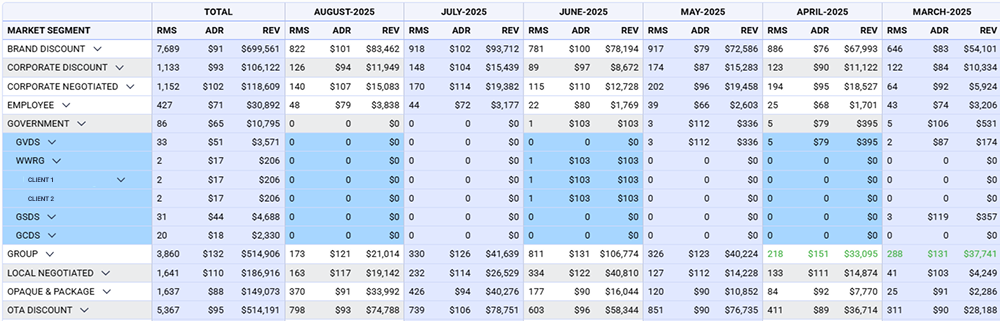
Historically, segmentation classified guests by purpose of travel, such as corporate, leisure, group, government, or transient. This approach allowed revenue managers to set broad pricing rules and forecast demand patterns.
While effective for basic planning, this model often ignored overlapping behaviours (e.g., a corporate traveller booking through an OTA) and missed micro-opportunities. RevEVOLVE captures multi-attribute segmentation, linking purpose of travel with booking behaviour, length of stay, and spend potential.
Evolved Thinking: Focus on the Channel
The shift to channel-based segmentation reflects the reality that the cost of acquisition is just as important as guest type. Different channels – direct booking, OTA, GDS, wholesalers, and corporate contracts – bring varied margins and booking lead times.
RevEVOLVE’s Channel Profitability Matrix allows RMs to:
- Compare net revenue per booking after commissions and fees.
- Identify channel cannibalisation risks.
- Optimise rate distribution to balance volume and profitability.
This is especially vital in competitive markets, where pushing more bookings through high-cost OTAs can erode profitability even when occupancy is strong.
The Next Stage: Focus on the Customer
Modern revenue optimization goes beyond who booked and where they booked; it’s about why they booked and how they behave. Customer-centric segmentation considers loyalty tier, past stay patterns, ancillary spend, and even sentiment analysis from reviews.
RevEVOLVE integrates guest profile analytics into its BI dashboard, enabling hyper-personalised offers, targeted upselling, and improved lifetime value tracking. For example, the system can recommend offering premium rooms at a discount to loyalty members during low-demand periods, boosting occupancy without over-discounting publicly.
What Does USALI Have to Do with It?
The Uniform System of Accounts for the Lodging Industry (USALI) provides the global standard for financial reporting in hospitality, ensuring consistency in how revenue is classified and analyzed.
By aligning segmentation with USALI categories, hotels can:
- Accurately track segment profitability.
- Ensure consistency in reporting for owners, brands, and asset managers.
- Link revenue data to operating expenses for true GOPPAR analysis.
RevEVOLVE automates USALI-compliant revenue categorization, eliminating manual reporting errors and giving RMs instant access to segment-level performance dashboards.
Conclusion – Segmentation as a Strategic Asset
Segmentation isn’t static; it evolves with market dynamics, distribution technology, and guest expectations. Whether the focus is travel purpose, booking channel, or customer behavior, the ability to track, analyze, and act on this data determines revenue strategy success.
With RevEVOLVE, segmentation moves from a data exercise to a strategic weapon enabling precise pricing, optimized channel mix, and measurable profitability improvements.
What to Expect in This Series
We’ve organized the series into two powerful sections:
Your Shift from Revenue Management to Revenue Strategy Starts Now.
Join the Journey with RevEVOLVE.ai – Exclusive Blogs, Brochures & Insights.
 sales@hotelswitchboard.com
 (855) 444-3967