If you’re an RMC owner reading this in early January, you’re probably doing the same thing we’re seeing across the industry: setting ambitious revenue goals for 2026.
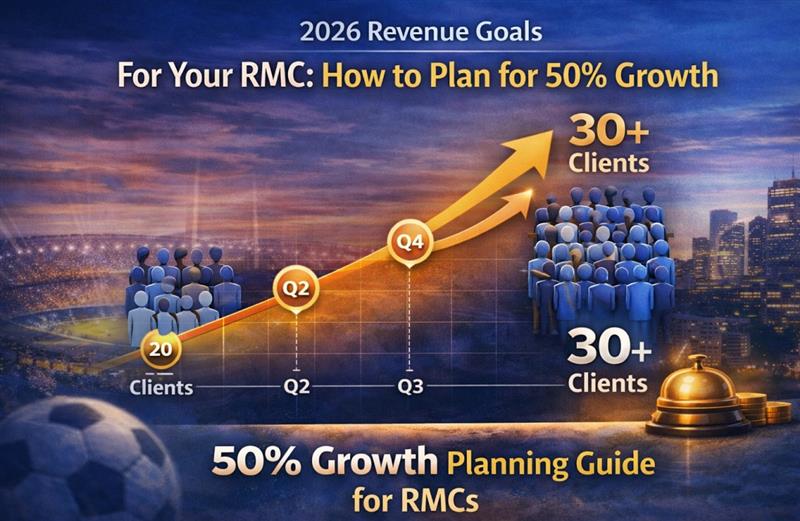
And if you’re like most RMC owners we talk to, you’re thinking about something in the 30-50% growth range. Maybe you’re managing 20 hotel clients today and want to get to 30. Or you’re at 35 and ready to push toward 50+.
Here’s the challenge: Most RMC owners set big revenue goals but don’t have a clear, actionable plan to actually achieve them.
You know you need to grow. You know the opportunity is there. But when you sit down to figure out how you’ll actually get from $720,000 in annual revenue to $1.08M (50% growth), the path forward gets murky.
This article breaks down exactly how to plan for 50% revenue growth in 2026-with specific frameworks, financial models, and strategic decisions that successful RMCs are using to scale profitably.
Let’s get into it.
Start with the Math: What Does 50% Growth Actually Mean?
Before we talk strategy, let’s ground this in reality with some math.
Example RMC: Current State
Let’s say you’re running an RMC with this profile:
- 20 hotel clients
- $3,000 average monthly fee per client
- $60,000 monthly revenue
- $720,000 annual revenue
50% growth means:
- Target annual revenue: $1,080,000 ($1.08M)
- Target monthly revenue: $90,000
- Required new clients: 10 additional clients (assuming same $3,000/month fee)
- Total portfolio: 30 clients by end of 2026
That means you need to:
- Acquire 10 new clients (or more if you have churn)
- Retain your existing 20 clients (or acquire extras to offset churn)
- Maintain or increase your average fee ($3,000/month)
Sounds straightforward, right?
Not so fast. The real question isn’t whether you can acquire 10 clients-it’s whether you can service 30 clients profitably with your current business model.
That’s where most RMCs get stuck.
The Brutal Truth About Traditional RMC Scaling
Here’s what typically happens when RMCs try to grow 50%:
Traditional Approach:
Current state (20 clients):
- 2 full-time revenue managers
- Each RM manages ~10 clients (which is already stretching it)
- $140,000 annual RM salary costs
- 80% profit margin
To reach 30 clients traditionally:
- Need to hire 1 more full-time RM
- New salary cost: $70,000 + benefits (~$28,000) = $98,000
- Your profit margin just dropped from 80% to 68%
And here’s the real problem:
- It takes 3-6 months to find, hire, and train a qualified RM
- Your growth stalls while you search for talent
- Revenue managers are scarce and expensive
- Turnover risk means you might do this all over again in 2-3 years
Bottom line: Traditional scaling means your revenue grows 50%, but your profit margins shrink and your operational complexity increases dramatically.
There has to be a better way.
The New Model: Technology-Enabled Scaling
Let’s look at the same growth scenario with a different approach:
Technology-Enabled Approach:
Current state (20 clients):
- 2 full-time revenue managers
- Revenue management technology platform
- Each RM manages ~20 clients (2x capacity through automation)
- Platform cost: ~$24,000/year ($1,200 per client)
To reach 30 clients with technology:
- Same 2 revenue managers (no new hiring)
- Each RM now manages 15 clients
- Platform cost scales: $36,000/year ($1,200 × 30)
- Profit margin stays at 78% (even better than traditional)
Why this works:
- Technology automates 60-70% of routine RM tasks
- Your RMs focus on high-value strategic work
- No hiring delays-you can scale immediately
- No turnover risk-technology doesn’t quit
- Margins improve as you grow
This is how the fastest-growing RMCs are scaling in 2026.
Now let’s break down the step-by-step plan to make this happen.
Your 50% Growth Planning Framework (6 Steps)
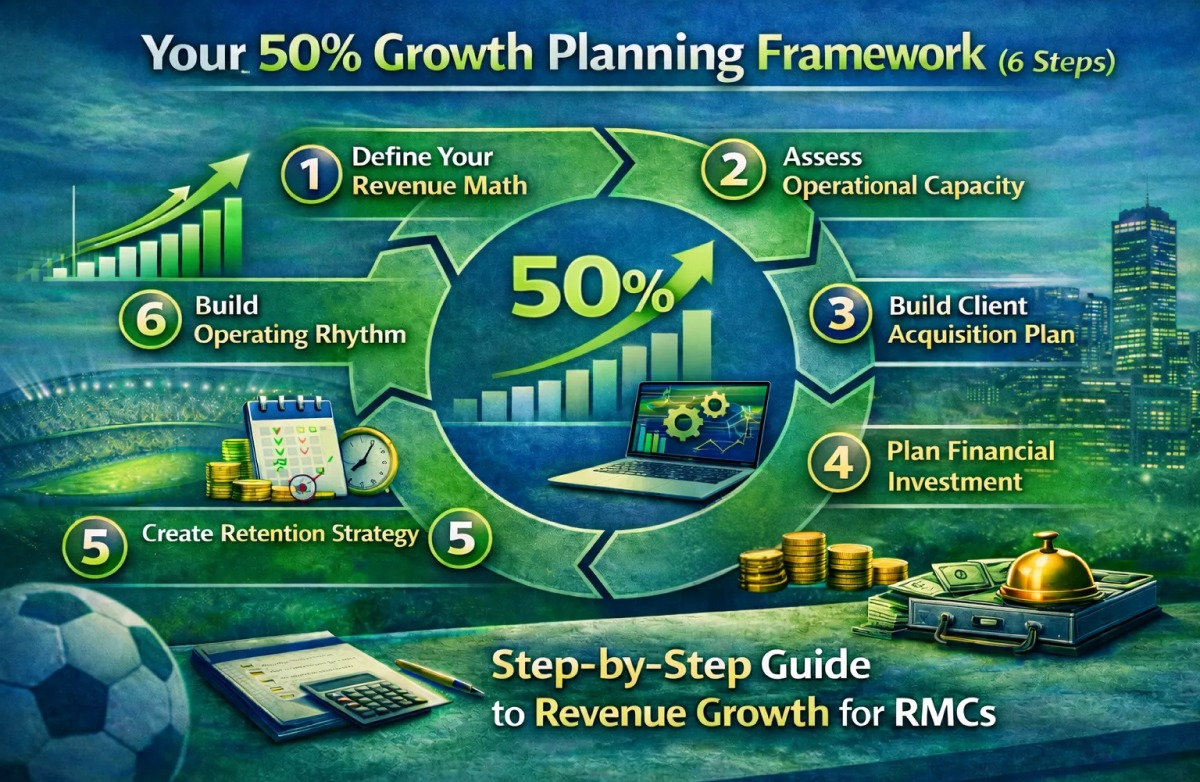
Step 1: Define Your Revenue Math
Start by getting crystal clear on your numbers.
Use this worksheet:
Current Monthly Revenue: $__________
Target Growth Percentage: _______% (e.g., 50%)
Target Monthly Revenue: $__________ (Current × 1.5)
Target Annual Revenue: $__________
Current Clients: _______
Average Monthly Fee: $__________
Required Total Clients: _________ (Target Monthly Revenue ÷ Avg Fee)
New Clients Needed: _________ (Required Total – Current)
Expected Annual Churn: _______ clients (typically 15-25%)
Gross New Clients Needed: _________ (New Clients + Expected Churn)
Example:
- Current: 20 clients at $3,000/month = $60,000/month
- Target: 50% growth = $90,000/month
- Required: 30 total clients
- New clients needed: 10
- Expected churn: 4 clients (20%)
- Gross new clients to acquire: 14 clients
This is your acquisition target for 2026.
Step 2: Assess Your Operational Capacity
Critical question: Can your current team handle 30 clients?
Traditional capacity calculation:
- Industry standard: 10-15 clients per revenue manager max
- 20 clients = 2 RMs (at capacity)
- 30 clients = 3 RMs needed
- Gap: Need to hire 1 more RM
Technology-enabled capacity:
- With automation: 20-25 clients per revenue manager
- 20 clients = 2 RMs (moderate utilization)
- 30 clients = 2 RMs (still manageable)
- Gap: Zero-current team can handle growth
Decision point: How will you handle the capacity challenge?
Option A: Hire proportionally (traditional approach)
- Pros: Maintains current service model, no technology learning curve
- Cons: Expensive, slow, risky, shrinks margins
Option B: Implement technology (modern approach)
- Pros: Fast, scalable, maintains margins, competitive advantage
- Cons: Initial implementation effort, team must adapt
Option C: Hybrid approach
- Implement technology first (6-12 months)
- Add staff only if needed after technology leverage
Our recommendation: Start with Option B or C. Technology gives you the flexibility to scale without being constrained by hiring.
Step 3: Build Your Client Acquisition Plan You need 14 new clients in 2026. Here’s how to get them: Acquisition Channel Breakdown Based on industry data, plan to acquire clients through these channels: 1. Referrals from Existing Clients (35% = 5 clients) Action: Implement formal referral program in Q1 Incentive: 1 month free service for successful referrals Goal: 2 referrals per quarter from satisfied clients 2. Competitive RFPs (30% = 4 clients) Action: Improve RFP response with technology positioning Target: Respond to 20 RFPs (20% win rate = 4 wins) Differentiator: Position tech-enabled capabilities 3. Direct Outreach/Sales (20% = 3 clients) Action: Dedicated sales outreach campaign Target: 10 qualified meetings per month (2-3% close rate) Focus: Hotels currently managing revenue in-house 4. Digital Marketing/Inbound (15% = 2 clients) Action: Content marketing, LinkedIn presence, SEO Target: 50 qualified leads per quarter (2% close rate) Content: Thought leadership on RMC trends Total: 14 new clients through diversified channels Quarterly Acquisition Targets Don’t try to get all 14 clients in December. Spread it out: Q1: 3 new clients (ramp-up phase) Q2: 4 new clients (momentum building) Q3: 3 new clients (summer slowdown) Q4: 4 new clients (year-end push) This pacing gives you time to onboard clients properly and adjust tactics based on what’s working.
Step 4: Plan Your Financial Investment
Growth requires investment. Here’s where to allocate budget:
Technology Investment
If implementing revenue management platform:
- Setup/implementation: $5,000-10,000 (one-time)
- Annual platform cost: $24,000-36,000 (scales with clients)
- Total Year 1: $29,000-46,000
ROI on technology:
- Enables 2 RMs to manage 30 clients instead of 20
- Avoids hiring cost of $98,000/year (salary + benefits)
- Net savings: $52,000-69,000 in Year 1
Sales & Marketing Investment
To acquire 14 new clients:
- Marketing content/collateral: $6,000-12,000
- Digital advertising: $12,000-24,000
- Industry events/conferences: $8,000-15,000
- Sales tools/CRM: $3,000-6,000
- Total: $29,000-57,000
Cost per acquisition: $2,071-4,071 per new client
Payback period: 1 month of fees (if $3,000/month client fee)
Operations Investment
- Additional training: $3,000-5,000
- Enhanced reporting tools: $2,000-4,000
- Client onboarding improvements: $2,000-3,000
- Total: $7,000-12,000
Total Investment for 50% Growt
Year 1 total investment: $65,000-115,000
Return on investment:
- Additional annual revenue: $360,000 (12 months × $30,000)
- Incremental profit (75% margin): $270,000
- ROI: 235-415%
The math works. Now let’s talk execution.
Step 5: Create Your Client Retention Strategy
You can’t grow 50% if you’re losing clients out the back door.
Industry average RMC churn: 20-25% annually. That’s unacceptable if you want to scale.
Here’s how to reduce churn to under 10%:
Retention Tactic 1: Deliver Consistent Results
Technology helps here:
- Automated pricing reduces human error
- Consistent processes across all clients
- Real-time optimization vs. manual delays
- Result: More predictable client outcomes
Retention Tactic 2: Professional Reporting
Clients leave when they can’t see your value:
- Monthly performance reports (automated)
- Clear ROI attribution (vs. static pricing)
- Competitive benchmarking
- Forward-looking insights
- Result: Undeniable proof of value
Retention Tactic 3: Proactive Communication
Don’t wait for clients to complain:
- Quarterly business reviews (scheduled)
- Monthly check-in calls
- Immediate response to performance dips
- Strategic recommendations vs. just execution
- Result: Clients feel partnered with, not just serviced
Retention Tactic 4: Raise the Switching Cost
Make it painful to leave:
- Deep integration with their operations
- Custom reporting they can’t get elsewhere
- Historical data and trend analysis
- Relationships across their organization
- Result: Leaving you means starting over
Target: 90%+ retention rate in 2026
If you retain 18 of 20 current clients (90%) and add 14 new clients:
- End of year: 32 clients (exceeds 30-client goal)
- Revenue: $96,000/month = $1.152M/year
- Actually achieved: 60% growth
Retention is a growth strategy.
Step 6: Build Your Monthly Operating Rhythm
50% growth doesn’t happen by accident. You need systems.
Here’s your monthly operating cadence:
Week 1: Performance Review
Monday:
- Review all client performance from previous month
- Identify underperformers requiring attention
- Analyze trends across portfolio
Tuesday-Wednesday:
- Client check-in calls (focus on bottom quartile performers)
- Proactive outreach to flag issues before clients notice
Thursday:
- Team meeting: Share learnings, adjust strategies
- Review technology performance and optimization opportunities
Friday:
- Send monthly client reports (automated, then personalize)
Week 2: Strategic Planning
Monday:
- Sales pipeline review: Where are we on acquisition targets?
- Marketing performance: Which channels are working?
Tuesday-Thursday:
- Sales activities: RFP responses, prospect meetings, proposals
- Content creation: LinkedIn posts, case studies, thought leadership
Friday:
- Review financial metrics: Revenue, margins, forecast
- Adjust quarterly plan based on progress
Week 3: Client Development
Monday-Wednesday:
- Quarterly business reviews with key clients
- Upsell/cross-sell opportunities
- Referral requests from satisfied clients
Thursday-Friday:
- Prospect nurturing: Follow-up with warm leads
- Industry networking: LinkedIn engagement, conference planning
Week 4: Team & Systems
Monday-Tuesday:
- Team training and development
- Technology optimization and process improvements
Wednesday-Thursday:
- Case study development from strong client results
- Marketing content production
Friday:
- Month-end planning: Set priorities for next month
- Celebrate wins, adjust what’s not working
This rhythm keeps you focused on the activities that drive 50% growth.
Your 2026 Quarter-by-Quarter Roadmap
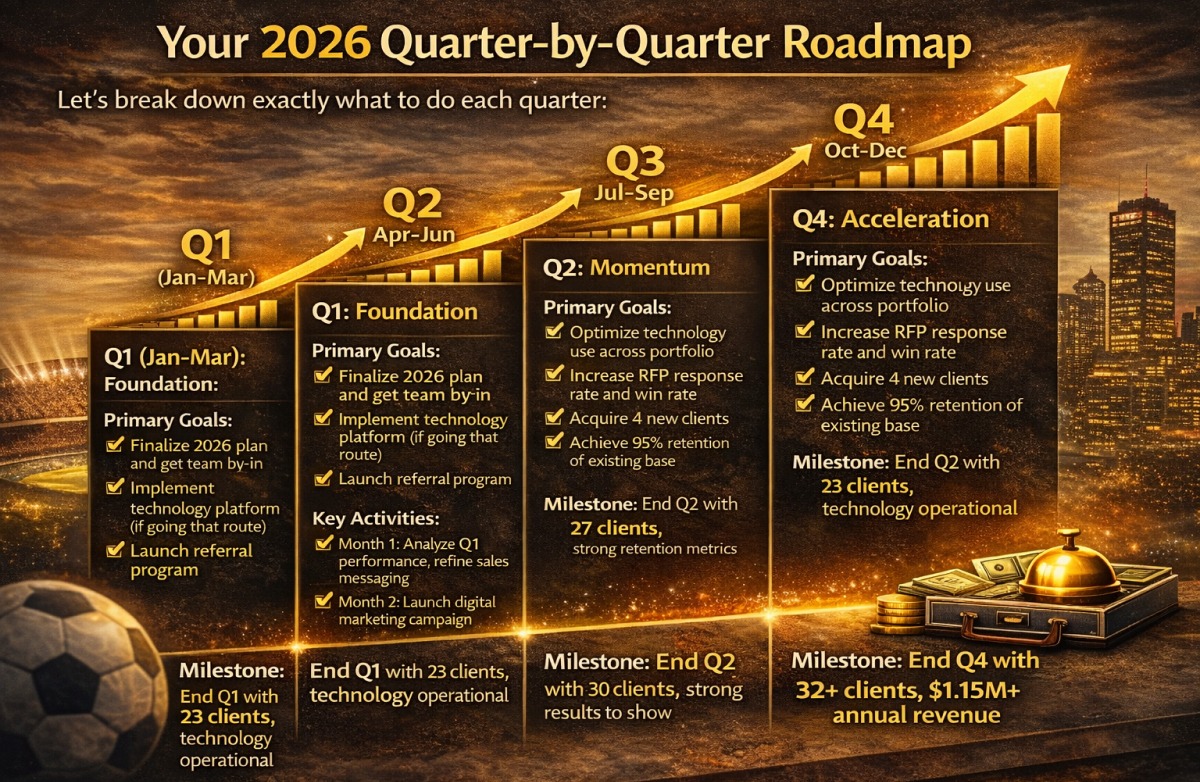
Let’s break down exactly what to do each quarter:
Q1 (Jan-Mar): Foundation
Primary Goals:
- Finalize 2026 plan and get team buy-in
- Implement technology platform (if going that route)
- Launch referral program
- Acquire 3 new clients
Key Activities:
- Week 1-2: Technology selection and contracting
- Week 3-6: Implementation across current 20 clients
- Week 7-12: Sales push using new capabilities as differentiator
- Ongoing: Begin enhanced client reporting
Milestone: End Q1 with 23 clients, technology operational
Q2 (Apr-Jun): Momentum
Primary Goals:
- Optimize technology use across portfolio
- Increase RFP response rate and win rate
- Acquire 4 new clients
- Achieve 95% retention of existing base
Key Activities:
- Month 1: Analyze Q1 performance, refine sales messaging
- Month 2: Increase RFP volume, improve competitive positioning
- Month 3: Launch digital marketing campaign
- Ongoing: Quarterly business reviews with all clients
Milestone: End Q2 with 27 clients, strong retention metrics
Q3 (Jul-Sep): Consistency
Primary Goals:
- Maintain acquisition pace despite summer slowdown
- Acquire 3 new clients
- Achieve portfolio consistency (reduce performance variance)
- Develop case studies from strong performers
Key Activities:
- Month 1: Mid-year strategic review and adjustment
- Month 2: Case study development and promotion
- Month 3: Conference attendance and networking
- Ongoing: Focus on client success to drive referrals
Milestone: End Q3 with 30 clients, proven results to showcase
Q4 (Oct-Dec): Acceleration
Primary Goals:
- Year-end sales push
- Acquire 4 new clients
- Exceed 30-client goal
- Plan for 2027 continued growth
Key Activities:
- Month 1: Leverage case studies in sales process
- Month 2: Year-end budget cycle sales (hotels planning for 2027)
- Month 3: Client appreciation and referral harvest
- Ongoing: 2027 planning with expanded team capacity
Milestone: End Q4 with 32+ clients, $1.15M+ annual revenue
How to Know If You’re on Track
Monthly KPIs to monitor:
Acquisition Metrics
- Sales pipeline value (target: $150,000+ at all times)
- New client meetings (target: 10 per month)
- RFP responses (target: 4-5 per month)
- Close rate (target: 20%+ on RFPs, 10%+ on outreach)
Retention Metrics
- Client churn rate (target: <10% annually = <1% monthly)
- Client satisfaction score (target: 4.5+/5.0)
- Quarterly business review completion (target: 100%)
- Performance consistency (target: 90%+ clients hitting goals)
Financial Metrics
- Monthly recurring revenue (target: +$2,500/month average)
- Profit margin (target: maintain 75%+)
- Revenue per RM (target: $540,000/year per RM)
- Client acquisition cost (target: <2 months of fees)
Operational Metrics
- Clients per RM (target: 15-20 with technology)
- Average time to onboard new client (target: 2-3 weeks)
- Technology adoption rate (target: 100% of clients)
- Team satisfaction score (target: 4.0+/5.0)
If you’re hitting 80%+ of these KPIs each month, you’re on track for 50% growth.
Common Pitfalls to Avoid
Pitfall 1: Growing Too Fast Without Infrastructure
Mistake: Acquiring 10 clients in Q1, overwhelming your team, and delivering poor service.
Solution: Stick to quarterly pacing. Build capacity before you fill it.
Pitfall 2: Competing on Price to Hit Growth Goals
Mistake: Dropping fees to $2,500/month to close deals faster.
Reality: You now need 36 clients instead of 30 to hit revenue goal-and your margins are crushed.
Pitfall 3: Neglecting Existing Clients While Chasing New Ones
Mistake: Focusing 100% on new business while existing clients churn.
Reality: You’re running on a treadmill. Acquire 14, lose 5, net +9 clients.
Solution: Balance 60% effort on retention, 40% on acquisition.
Pitfall 4: Delaying Technology Investment
Mistake: “We’ll implement technology once we’re bigger.”
Reality: You can’t GET bigger without it. You hit capacity ceiling and growth stalls.
Solution: Implement technology in Q1 before you’re drowning. Prevention is easier than rescue.
Pitfall 5: No Clear Quarterly Milestones
Mistake: “We want to grow 50% this year” with no quarterly breakdown.
Reality: December arrives, you’re at 20% growth, and you don’t know where you went wrong.
Solution: Set quarterly targets and review monthly. Adjust course early if you’re off track.
Real-World Example: How One RMC Achieved 52% Growth
Pacific Revenue Management (name changed for confidentiality):
Starting point (Jan 2025):
- 18 hotel clients
- 3 full-time RMs
- $54,000 monthly revenue ($648,000/year)
- Growing but hitting capacity constraints
Their 2025 plan:
- Target: 50% growth (27 clients)
- Strategy: Implement RevEVOLVE technology in Q1
- Focus: Leverage technology to scale without hiring
What actually happened:
- End Q1: 20 clients
- End Q2: 25 clients
- End Q3: 27 clients
- End Q4: 32 clients (instead of 27 target)
Final Results:
- Revenue: $96,000/month ($1.152M/year)
- Growth: 78% vs. 50% target
- Team: Still 3 RMs (no new hiring)
- Clients per RM: 10.6 (vs. 6 previously)
- Profit margin: 82% (vs. 74% previously)
Key to success: Technology created leverage that allowed them to exceed growth goals without proportional cost increases.
Your Next Steps
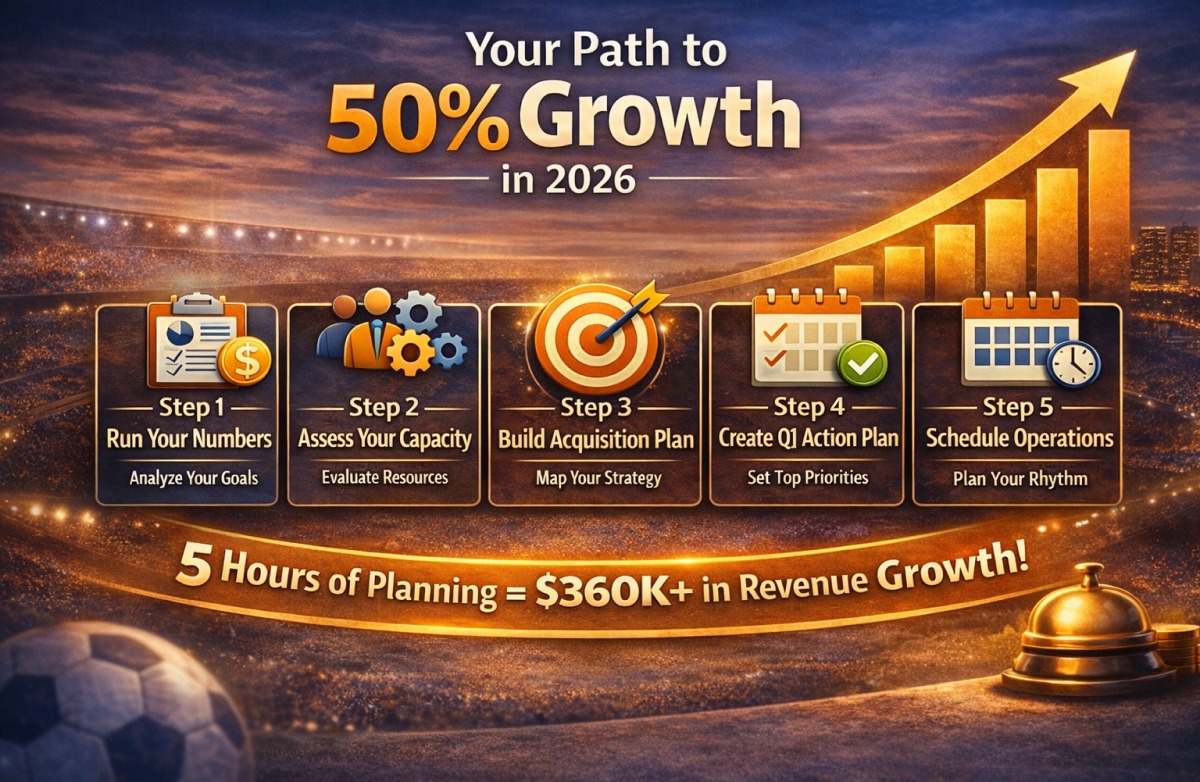
If you’re serious about 50% growth in 2026, here’s what to do this week:
Step 1: Run Your Numbers (30 minutes)
Use the worksheet from Step 1 of this article. Get crystal clear on:
- Current state
- Target state
- Gap to close
Step 2: Assess Your Capacity (1 hour)
Honestly evaluate:
- Can your current team handle 50% more clients?
- What’s your plan to close the capacity gap?
- Technology? Hiring? Both?
Step 3: Build Your Acquisition Plan (2 hours)
Map out:
- Which channels will you focus on? (Referrals, RFPs, outreach, inbound)
- How many leads/meetings do you need per month?
- What’s your conversion rate target?
- Quarterly acquisition goals
Step 4: Create Your Q1 Action Plan (1 hour)
Get specific about January-March:
- What are the top 3 priorities?
- What do you need to implement in Q1 to enable Q2-Q4 growth?
- Who’s responsible for what?
Step 5: Schedule Your Monthly Operating Rhythm (30 minutes)
Block time on your calendar for:
- Week 1: Client performance reviews
- Week 2: Strategic planning and pipeline review
- Week 3: Client development and QBRs
- Week 4: Team development and content creation
Total time investment: 5 hours to plan for $360,000+ in additional revenue.
That’s a pretty good ROI on your time.
Final Thoughts
50% growth is ambitious-but it’s absolutely achievable with the right plan.
The RMCs that will hit this goal in 2026 have three things in common:
- Clear financial targets with quarterly milestones
- Operational leverage through technology (not just adding bodies)
- Disciplined execution with monthly operating rhythm
The RMCs that will miss this goal:
- Set vague aspirational targets without a plan
- Try to scale using the traditional model (hire proportionally)
- Chase growth without building systems and infrastructure
Which path will you choose?
Start planning today. Your Q4 2026 self will thank you.